I remember the exact moment. Or… okay, I think it was a Tuesday. The kitchen was a total disaster—like flour on the floor from some failed pancake attempt, something sticky under my foot that I was too tired to investigate, and a coffee mug that I had already reheated… what, four times? Maybe five. I don’t even know anymore. I was standing there like—okay. This is it. I’m doing it.
⚡ GAGGING VS CHOKING SIGNS BABY: THE QUICK ANSWER
If your baby is making noise, they are safe. Knowing the difference between Gagging vs Choking Signs baby is the #1 rule for starting solids.
- GAGGING (Loud & Red): If your baby is coughing, sputtering, or making an “ack-ack” sound, they are effectively clearing their airway. Stay calm and do not intervene.
- CHOKING (Silent & Blue): If your baby is silent, cannot breathe, or their lips are turning blue, this is an emergency. Act immediately and perform infant back blows.
The Golden Rule: Loud is good. Silence is the danger sign.
I was about to offer my six-month-old a piece of steamed broccoli. Not a puree. Not the usual safe, predictable spoon of mush that just slides in and out without drama. No. This was an actual piece of food. A real one. Like… a tiny green tree.It was the moment I’d been dreading and excited for all at once, but suddenly, all those Google searches about gagging vs choking signs baby started swirling in my head like a fever dream. I was standing there, staring at that broccoli, and honestly, I’ve never felt more like a first-time mom in my entire life.
And I just stood there for a second thinking—wait. Is this a good idea? Shota, should you be doing this? Is this how people end up in the ER over vegetables? Honestly, it felt way too serious for something that’s literally just broccoli. My heart was doing this ridiculous drum solo against my ribs—like, not even subtle. I had my phone right there on the counter… emergency number typed in already. I just hadn’t pressed “call.” Yet.
And yeah, okay, it sounds dramatic. I know. But if you’re a mom… you get it. That first solid meal doesn’t feel normal. It feels like you’re playing some high-stakes game and no one bothered to explain the rules. I remember just watching her… those tiny, chubby fingers reaching out, grabbing the broccoli like it was no big deal. No hesitation. Meanwhile, I’m internally spiraling, trying to mentally checklist every gagging vs choking signs baby guide I’d ever skimmed at 2 AM. My brain was just a loop of: Is she breathing? Is that a cough? Is she okay?
And then… there was just this weird, heavy pause. Like my brain didn’t catch up yet.
The face went bright red. Eyes started watering immediately. Then came that weird, rhythmic, guttural “ack-ack-ack” sound — like a broken garbage disposal trying to work but absolutely failing. And honestly… my brain just went blank for a second. I was this close to grabbing him, flipping him over, yelling for help, doing something—anything. I felt that shot of adrenaline hit my stomach like a physical punch.
And then it just… stopped. Like nothing had happened. He spat out this mashed-up green clump, looked at me, grinned — full broccoli all over his face, somehow even in his eyebrows — and reached for the next piece like we hadn’t just almost had a full panic moment. He was fine. He wasn’t choking. He was just gagging.
But in that split second, I realized that knowing how to tell difference between gagging and choking is the only thing that keeps us from ending up in the ER every time we offer an avocado slice. If I didn’t know the difference, I would have spent my entire motherhood in a state of permanent, vibrating anxiety.
The Science of the “Ack”: Why Babies Gag So Much (And Why We Panic)


Let’s take a breath for a second. If you’re currently sitting on your kitchen floor because your baby just gagged on a crust of bread and your hands are still shaking—I’ve been there. I’ve literally sat on my hands, physically squeezing them under my thighs, just to keep myself from “saving” them. It is quite literally the hardest thing I’ve ever had to do in my kitchen, and I’ve tried making sourdough from scratch, so that’s saying something. I remember staring at him and desperately trying to figure out when to worry about baby gagging reflex and when to just let him work it out on his own.
And here’s the thing nobody really tells you… like, not in a calm Instagram caption, not in those parenting books that sound like they were written by robots. It’s just… the baby is kind of built for this. Not for us panicking over it, but for this moment.
Around six months, the gag reflex isn’t where you think it is. It’s way, way forward on their tongue. Like… uncomfortably forward. Meanwhile, ours is back near the throat, all mature and quiet. So for them? It’s basically this built-in security guard sitting way too early on the highway going, “nope, turn back, try again,” before anything even gets close to dangerous.
And once you see it happen a few times, you start realizing… oh. That loud, dramatic, scary gagging? That’s actually the system working perfectly. This is a biological safety net. When you see your baby gagging on solids but not choking, it’s actually their body saying, “Whoa, buddy! That piece is a bit too big, let’s move it back to the front so we can chew it some more.” It’s a learning mechanism. They are literally mapping out the geography of their own mouths.
If they didn’t gag, they wouldn’t learn where the “danger zone” is. Think of it as a toddler learning to walk—they’re going to stumble, they’re going to fall on their butt, and gagging is just the “stumble” of the mouth. You wouldn’t stop them from walking just because they tripped, right?
The Red Face vs. The Blue Face: Gagging vs Choking Signs Baby
If you want to stay sane through this whole solid food journey, you need to memorize the most important gagging vs choking signs baby rule. Write it on your fridge, or better yet, on your hand, because in a moment of panic, you won’t have time to Google it.
Loud and red? Go ahead. Silent and blue? They need you.
Gagging is loud. It’s dramatic. It involves coughing, sputtering, watery eyes, and often a very red (sometimes purple-ish from the effort) face. It looks like they are struggling, and every instinct you have will tell you to jump in. But here’s the key: air is still moving. You can hear it. As long as they are making noise, they are clearing their own airway. I remember sitting there, watching my little one struggle with a piece of banana, and my brain was screaming “DO SOMETHING!” but his lungs were literally saying “I’M WORKING ON IT, MOM, CHILL!”
Choking, on the other hand, is terrifyingly, hauntingly quiet. Real choking happens when the airway is completely blocked. There is no air moving, which means there is no sound. No coughing. No crying. No “ack-ack” noise. Their face might start to turn a bluish or greyish tint, and they will have this look of sheer, wide-eyed panic. It’s the silence that’s the killer. When you’re frantically searching for gagging vs choking signs baby, this silence is the one sign you never want to face. It’s the silence that makes your blood run cold.
This is why “distracted eating” is the real enemy. If you’re scrolling on your phone or trying to finally fold that mountain of laundry with your back turned, you will hear a baby gag. You will not hear a baby choke. So, yeah, put the phone down. The laundry has been sitting there for three days, it can wait another twenty minutes.
The “No Teeth” Myth: Gums are Stronger than You Think
I can’t tell you how many times my own mother or the neighbor has said, “But she doesn’t have any teeth! How is she supposed to eat anything but soup?” Honestly, after the tenth time, it’s enough to make you doubt your own name.
But here’s a secret: babies have incredibly strong gums. If you’ve ever had your nipple chomped on during a 3 AM feeding, or had a four-month-old lock their jaws onto your finger, you know exactly what I’m talking about. My God, those gums are like vice grips. They don’t need molars to mash soft food. When I was looking for safe finger foods for 6 month old with no teeth, I was terrified of anything harder than a lukewarm noodle. But then I learned about the “squish test,” and it changed everything.
If you can mash the food easily between your thumb and forefinger, your baby can mash it with their gums.
- Steamed sweet potato wedges: Cut them long like a big fry so they can actually grip them with their palm.
- Very ripe avocado spears: Though, let’s be real, 90% of it ends up as a hair mask or smeared on the underside of the table.
- Omelet strips: The perfect “squishy” food that provides protein and is easy to gum.
- Banana Halves: Peel just a bit so they have a “handle” to hold onto.
These foods allow them to practice “chewing” without the risk of a hard chunk breaking off before they are ready.
Why I Had to “Sit on My Hands” (And Why You Should Too)


The hardest part of being a mom in those early days is fighting the “finger sweep” urge. When you see a piece of food hanging out in the back of their mouth, every fiber of your being wants to reach in there and hook it out.
Don’t. Do. It.
I know that feeling… like if you just sit there and watch, you’re somehow doing it wrong. Like a “bad mom” moment is about to be officially logged somewhere. But here’s the thing I had to learn the hard way: sticking your finger in their mouth to “help” doesn’t actually help. It can push the food further back, and suddenly a normal gag turns into a real choking incident because you moved the food into the airway.
So yeah… I’ve literally had to sit on my hands. Physically. Like, I’d tuck them under my butt and just watch her. My body was screaming “DO SOMETHING,” but my brain was just trying to stay calm. My husband used to look at me like I was slightly unwell during those meals. And maybe I was. But I also knew this weird, heavy truth: seeing your baby gagging on solids but not choking is a test of your sanity. If I panic, she panics. And once a baby panics with food in their mouth? They take that sharp little gasp in, and that’s exactly how food gets sucked into the windpipe.
When to Worry About Baby Gagging Reflex
I get asked this a lot: when to worry about baby gagging reflex? Because let’s be honest, at some point, you start wondering if this is ever going to end or if you’re just torturing your child. Most babies will stop gagging so frequently after a few weeks of practice. However, you should probably talk to a professional if:
- Your baby gags so hard they vomit at every single meal (once in a while is normal, every time is a lot).
- They seem genuinely terrified of food or start crying the moment they see the high chair.
- They aren’t able to move food from the front of their mouth to the back by 9 or 10 months.
For most of us? It’s just a phase. A messy, heart-attack-inducing phase that involves a lot of floor scrubbing.
High Chair Posture: The 90-90-90 Rule
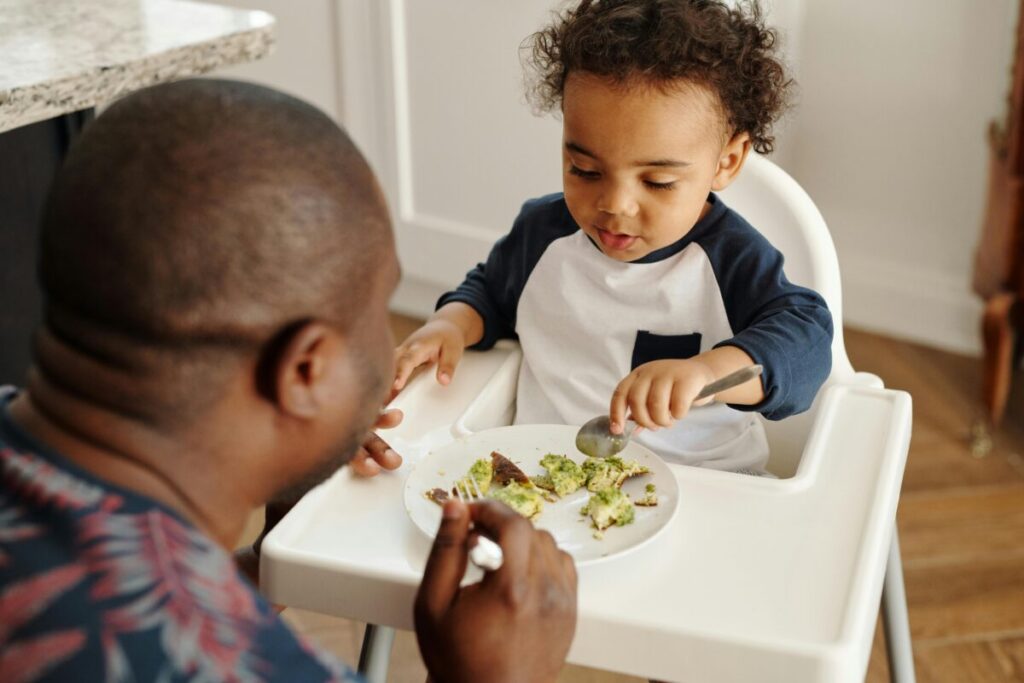
We talk a lot about what the baby is eating, but not enough about how they are sitting. Imagine trying to swallow a piece of steak while slumped over in a beanbag chair. You’d probably struggle too.
If your baby is leaning back in their high chair or slumped to the side, gravity is working against them. You want them sitting bolt upright. We call it the 90-90-90 rule: 90 degrees at the hips, 90 at the knees, and 90 at the ankles.
A footrest is actually a huge deal. If their legs are just dangling, they don’t have the core stability to cough effectively. I didn’t have a footrest on my first chair, so I literally duct-taped a thick book (sorry, Charles Dickens, you were a great footrest) to the chair so my baby had something to push against. It looked ridiculous—proper DIY-fail—but his gagging decreased almost immediately because he felt secure. It’s funny, we spend hours researching safe finger foods for 6 month old with no teeth, but we forget that if their feet aren’t stable, even the softest avocado can be a struggle for them.
Practical Tips for the Messy Transition
- Check your vibe: If you are hovering over the high chair like a vulture, your baby will feel that tension. Put on some music. Hum. Try to look like you’re having a great time, even if your stomach is in knots.
- Water is your friend: Have a small open cup of water nearby. Sometimes a tiny sip helps “reset” the mouth after a big gag.
- Model the chewing: Sit in front of them and eat the same thing. Exaggerate your chewing. Open your mouth wide. They are little sponges; they will copy you.
- Keep it long: For finger foods, make them longer than the baby’s fist. If it’s too small, they might try to swallow it whole.
- Softness is key: Always test the food. If you can’t squish it, don’t give it.
- Avoid round shapes: No whole grapes, no cherry tomatoes, no round slices of hot dog. Always cut them lengthwise.
- Clean up later: Don’t try to wipe their face while they are eating. It’s distracting and can cause them to gasp. Let them be a messy monster until the meal is over.
- Trust the process: Gagging is progress. It means they are learning to be safe eaters.
The “Gagging vs Choking Signs Baby” Quick Cheat Sheet
(Screenshot this for those moments when you’re sure you’re doing everything wrong)
- GAGGING: It’s loud. It’s messy. Coughing, red face, chaos… but there’s sound. Air is moving. You’ll hear it even if your whole body is shaking.
- CHOKING: Silence, no air, blue/purple lips, wide-eyed silence. Action: This is an emergency. Call for help and perform infant back blows/chest thrusts.
- THE SQUISH TEST: If you can’t mash it with your fingers, it’s a no-go for now.
- THE GOLDEN RULE: Never, ever leave them alone. Choking is silent. You won’t hear it from the next room.
Hungry for more? (Don’t worry, the mess is worth it!)
If you’re still feeling that “new-mom” anxiety or just need more practical tips to survive the high chair chaos, check out these guides:
- Fearless Feeding: A Real-Mom Guide to Introducing the Top 8 Allergens – Because if gagging wasn’t scary enough, let’s talk about peanuts and eggs! (Spoiler: You’ve got this).
- My 7-Month-Old Refuses Solids: 5 Proven Tricks to Try Today – For those days when the floor eats more than the baby.
- When Can My Baby Start Eating Baby Food? The Messy, Honest Guide to Starting Solids – A deep dive into the “Is it time yet?” question.
Final Thoughts from the Messy Kitchen
If you’re feeling like a nervous wreck, just know that you are in good company. Starting solids is a huge, scary, exciting milestone. It’s the end of the “only milk” era and the beginning of the “why is there broccoli in my bra and sweet potato on the ceiling?” era.
Take it one floret at a time. Put on some music to help keep the “mealtime vibes” chill. And remember—loud is good. Loud means they’ve got this. And even if you’re currently covered in avocado and haven’t showered since Sunday, you’ve got this too.
Now, go reheat that coffee for the fifth time. You earned it. 🚀✨
Disclaimer
I’m a mom sharing my real-life, messy experiences in the kitchen, not a doctor, pediatric nutritionist, or emergency medical professional. While I’ve done my homework and obsessively researched these topics, every baby is different. The information in this post is for educational and storytelling purposes only and should not be taken as medical advice. Always consult with your pediatrician before starting solids or if you have concerns about your baby’s eating habits. If you suspect your baby is choking, call emergency services immediately.