I still remember it — even though I’ve honestly tried to forget it. My son was 18 months old when we hit the dreaded 18-month sleep regression, and it felt like our world flipped overnight. We had the routine down: bath, pajamas, lavender mist, and soft lullabies. But one Tuesday night at 8:00 PM, something just flipped.
I sat on the nursery floor, head in my hands, crying into a cup of coffee I’d already reheated three times. I just kept thinking, “What did I mess up?”
If you’re reading this at 2:00 AM while your toddler practices their gymnastics in the crib, let me start by saying: You did nothing wrong. Welcome to the 18-month sleep regression. I’ve been working with parents for years, and I can tell you that this specific milestone is the “Boss Battle” of parenting. It’s physically exhausting, emotionally draining, and—I promise—perfectly normal.
So let’s break down what’s actually going on — and how to survive it. The “why,” the science, and most importantly, how we’re going to get your household sleeping again without losing your mind. If you feel like it’s not just the nights, but your entire day that has dissolved into a beautiful, messy whirlwind, you need to read my survival guide [Welcome to the 1.5-Year Mark: The Beautiful, Exhausting Chaos] to get the real tea on this exact milestone.
Why Now? The “Perfect Storm” of the 18-Month Milestone

The 18-month sleep regression is unique. It’s not like the 4-month or 6-month ones that are mostly about biological sleep cycles. At 18 months, It’s more about personality and independence — their brain is just going wild right now.
1. The Quest for Autonomy (The “I Do It” Phase)
Around this age, your toddler suddenly realizes they are a separate person from you. This is a big shift for them, but it’s a nightmare for bedtime. They’ve discovered the power of the word “NO.” When you say it’s bedtime, they don’t just hear an instruction; they hear a challenge.
This constant pushback is often part of a bigger developmental shift. If you feel like your house has turned into a battlefield of ‘NO,’ you might want to check out our deep dive on why your toddler says ‘no’ to everything. Understanding their need for control helps you hold your sleep boundaries without it turning into a three-hour power struggle.
In my years of consulting, I’ve seen that toddler bedtime battles are rarely about being “awake.” It’s a power struggle. They want to see: “If I scream, will Mommy stay? If I throw my pacifier for the tenth time, will Daddy come back?” They’re basically testing what works on you. And yeah… they’re very good at it.
2. Peak Separation Anxiety 2.0
Just as they’re craving independence, they get hit with a massive wave of separation anxiety. It’s honestly confusing — even for them. They want to do everything themselves, but the moment you close that nursery door, the world feels big and scary. This anxiety can make falling asleep independently—a skill they might have mastered months ago—feel like an impossible task. They aren’t being “bad”; they are genuinely worried you’re gone forever.
This peak in anxiety is a hallmark of the 18-month sleep regression, making it harder for toddlers to feel safe enough to drift off alone.
3. Language Explosion and Cognitive Growth
Their little brains are working overtime. They’re learning new words every hour, understanding complex instructions, and starting to “make-believe.” This mental activity doesn’t just shut off because you turned out the lights. Often, they stay awake simply because their brain is too busy “processing” the day’s adventures. It’s like their brain just won’t slow down.
4. Physical Factors: The teething phase (which is… not fun)
Teething and physical growth spurts also play a massive role in why the 18-month sleep regression feels so much more intense than previous ones.
Around 18 months, the canine teeth and those first molars are usually trying to punch through the gums. It’s painful. Combine that with the fact that many toddlers are transitioning from two naps to one, and their bodies are in a constant state of “overtiredness.” And as every parent knows, an overtired toddler is a toddler who cannot sleep.
According to the American Academy of Pediatrics, teething can cause significant discomfort that disrupts sleep patterns during this stage.
It’s also worth looking at what’s happening during the day. Sometimes, an accidental sugar rush in the afternoon can make the evening wind-down twice as hard. If you’re struggling to balance treats and energy levels, our guide on navigating sugar boundaries and tantrums might be the missing piece of your sleep puzzle.
The Symptoms Checklist: Is This Actually a Regression?
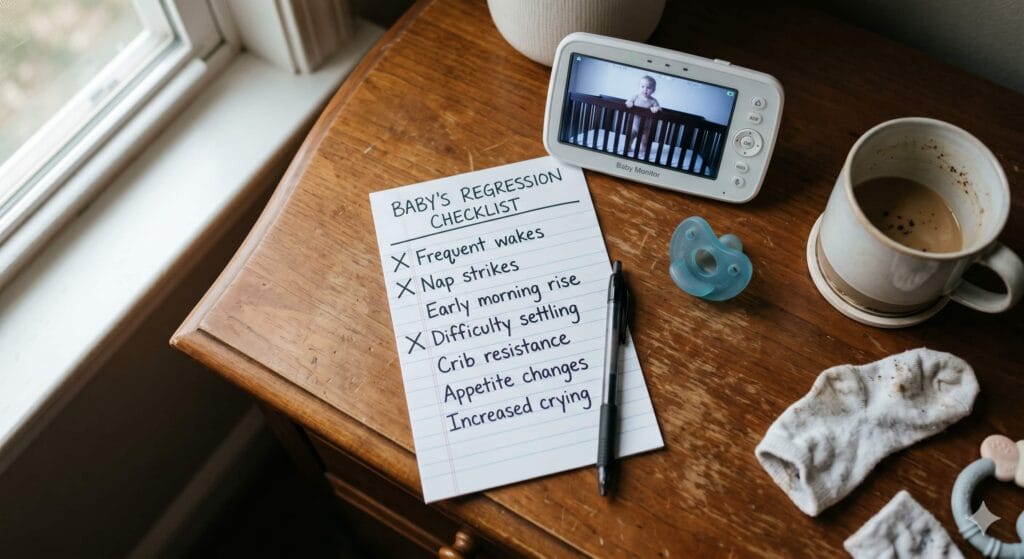
Not every bad night means a regression (sometimes it’s just a full moon or a weird dream). But if you see this pattern for more than 4 nights, you’re in the thick of it:
- The Crib Battle: A child who used to go down easy now treats the crib like they suddenly hate it.
- The “Split Night”: Waking up at 2:00 AM and staying awake—totally happy and ready to play—for two hours.
- The Nap Strike: Suddenly refusing the afternoon nap or waking up after 20 minutes, crying and cranky.
- The “Velcro” Toddler: Screaming the second you move toward the door, even if you’ve been in the room for an hour.
- Appetite Changes: Often linked to those molars coming in.
Your Step-by-Step Survival Plan (No Fluff Version)

You don’t just have to wait this out. We’re going to provide a structure that helps your toddler feel safe while keeping you from losing your sanity.
Step 1: Audit the Schedule (The 1-Nap Transition)
By 18 months, almost every toddler should be on a one-nap schedule. If your child is still trying to take two naps, they aren’t tired enough at 8 PM. If they’ve transitioned to one nap too early, they’re chronically overtired.
An incorrect nap schedule is often the hidden fuel behind a prolonged 18-month sleep regression, leading to chronic overtiredness.
A “sweet spot” schedule usually looks like this:
- Wake up: 7:00 AM
- Nap: 12:30 PM – 2:30 PM (No later!)
- Bedtime: 7:30 PM or 8:00 PM
The National Sleep Foundation recommends that toddlers between 1-2 years old get 11-14 hours of total sleep in a 24-hour period.
Step 2: The 30-Minute “Wind-Down” Routine
Consistency really helps with toddler anxiety. If you skip a step, they’ll sense it.
- Dim the lights: 30 minutes before bed, make the house look like a cave. It helps their body get ready for sleep.
This means turning off all gadgets, too. I know how tempting it is to use a cartoon as a ‘quick fix’ when you’re exhausted, but the blue light actually keeps their brain in overdrive. If you’re struggling with the ‘mom guilt’ of using devices to survive the day, you’ll find peace in our guide on finding balance with screen time. It’s about sanity, not perfection.
- The “Check-In” Story: Read exactly two books. No more. Don’t let them negotiate for a third.
- The Gratitude Moment: Talk about one fun thing from the day. This helps them “process” their thoughts so they don’t have to do it at 2 AM.
Step 3: Visual Boundaries (The “Okay to Wake” Clock)
Toddlers don’t understand time, but they understand colors. Get a clock that turns red for sleep and green for wake-up. I remember one toddler who woke up at 4:45 AM every day… We told him, “You don’t have to sleep, but you must stay in your ‘nest’ until the light is green.” It took a week of consistency, but it ended the 5 AM power struggles.
Step 4: The Chair Method for Separation Anxiety
If your kid is screaming because they’re scared you’re leaving, don’t just disappear. That builds more anxiety. Instead, sit in a chair next to the crib. Don’t talk, don’t play—just be a boring, silent presence. Every two nights, move the chair further away toward the door. Eventually, you’ll be in the hallway. It helps them feel safe while still keeping the boundary — they stay in bed.
The Chair Method is especially effective during the 18-month sleep regression because it addresses the separation anxiety without breaking your boundaries.
Common Mistakes: What NOT to Do (Zero Judgment Here)

When you’re exhausted, you just do whatever works in the moment. I’ve been there. But try to avoid these “accidental habits”:
- The “Accidental” Co-Sleeper: Bringing them into your bed “just for tonight” is a trap. To an 18-month-old, doing it once = they’ll expect it again. Tomorrow, they will fight twice as hard to get back into your bed.
- The “Milk/Tablet” Crutch: Giving a bottle or an iPad to “calm them down” makes it harder for them to actually sleep deeply. Plus, it’s a nightmare for their teeth.
This is also where many parents struggle with late-night nursing. If you feel like your toddler is only sleeping to nurse and you’re ready to start closing that chapter, it’s important to do it with care. Check out our gentle guide to weaning your toddler for a real-talk approach to saying goodbye to breastfeeding without the heartbreak or the extra sleep-deprived tears.
- The Negotiation: Don’t argue with a toddler. If they ask for water after they’ve already had it, the answer is a calm, “Water time is over. It’s sleep time.” If you give in, you’re teaching them that persistent crying gets results.
When Should You Call a Pro?

While most cases of 18-month sleep regression resolve with consistency, sometimes there are underlying issues that need professional attention.
Most regressions last 2 to 4 weeks. But consult your pediatrician or a specialist if:
- Your child is snoring or gasping for air (this could be sleep apnea).
- The regression lasts longer than 6 weeks with zero improvement.
- The lack of sleep is making you feel unsafe or severely depressed.
- There’s a sudden, unexplained weight loss or high fever.
At TinyCareTips.com, we always say: trust your gut. If you think something is physically wrong, get it checked.
Keep in mind that if your toddler has recently started daycare, their sleep might be disrupted by more than just developmental milestones. Constant sniffles can keep anyone up at night! You can check out our guide to daycare germs and building immunity to help your little one stay healthy and get back to their sleep routine faster.
FAQ: The Stuff Parents Actually Ask Me
“Should I move them to a big-kid bed now?” NO. Unless they are climbing out and it’s a safety hazard, keep them in the crib. An 18-month-old with the freedom to walk around the house at 3 AM is a disaster waiting to happen. If you want a real-world look at how this transition actually goes when the time finally comes, read our article on The Toddler Bed Transition: A Field Report From a Mom Who Debugs Systems for a Living (And Still Got Owned by a Two-Year-Old).
“Is it okay to use melatonin?” Talk to your doctor first. In my experience, melatonin is a band-aid. It might help them fall asleep, but it won’t fix the behavioral or developmental reasons they are waking up.
A Final, Exhausted Hug
I know your eyes are burning. I know the house feels quiet yet loud with the sound of your own heartbeat as you wait for the next cry.
This 18-month sleep regression is a sign that your baby is growing into a complex, intelligent human. It’s a massive “upgrade” to their soul, and like any software update, it’s buggy as hell.
Hold your boundaries with love. Stay consistent. And remember: You are the leader of your home. They are looking to you to see if the world is safe at night. Show them it is by staying calm.
This phase won’t last forever. One day you’ll drink your coffee while it’s still hot. And sleep… actual, uninterrupted sleep.
Keep going, Mama. Keep going, Papa. You’ve got this.
Remember, surviving the 18-month sleep regression is a marathon, not a sprint, and you are doing an incredible job.
If you’re dealing with toddler chaos in general, check out our guides on picky eating and tantrum survival over at TinyCareTips.com.