
I fix broken systems for a living. Give me a server that’s throwing errors at 3 a.m. and I will calmly trace the log, isolate the fault, and patch it without breaking a sweat. I like root causes. I like reproducible steps. I like knowing that if I do X, Y will reliably follow.
Then I had a toddler, and I learned that none of that applies to human beings under three feet tall.
I want to be honest with you before we go any further: I did not want to leave the crib. The crib was my system. It was contained, predictable, and had walls. My kid went in, my kid (mostly) stayed in, and I got to sleep believing I had some semblance of control over the household. The toddler bed transition was not on my roadmap. I had penciled it in for “later,” which is technician-speak for “never, if I can help it.”
The universe, as it turns out, does not care about your roadmap. Mine had other plans, and they involved my son and the crib rails, one Tuesday night, doing something that still lives rent-free in my head.
The universe, as it turns out, does not care about your roadmap. Mine had other plans, and they involved my son and the crib rails, one Tuesday night, doing something that still lives rent-free in my head. If you are trying to figure out whether you’re at this stage yet, you can read our detailed guide on The Crib to Bed Transition: How to Move Your Toddler Without Losing Your Mind to spot the early behavioral cues.
Toddler Bed Transition: Forget the Calendar, Watch the Behavior


Every parenting article on the planet will tell you the “ideal” age for when to transition toddler to bed is somewhere between 18 months and 3 years. Cool. Great. Very helpful. Except toddlers have never once in the history of humanity read a parenting article, so they do not care what the ideal window is.
Here’s what actually happens: your kid gives you a signal, and the signal is usually loud, physical, and terrifying.
For us, the signal arrived the night my son decided the crib rails were a personal challenge issued directly to him. I walked in to check on him and watched, in real time, as he scaled the side of that crib like a tiny, determined spider monkey — one foot braced on the bumper, one hand gripping the rail, full commitment in his eyes — and then, because toddlers have the balance of a drunk toddler (because they are one), he face-planted straight onto the rug below.
He was fine. Startled, offended, but fine. I was not fine. I stood there doing the math any technician does when a system fails because of toddler climbing out of crib: severity of the failure, likelihood of recurrence, cost of doing nothing. The math was not subtle. He was going to do that again. And again. And eventually he was going to time it wrong and land on the hardwood instead of the rug, or catch a limb on the way down.
That’s your real answer to “when to transition.” Not a birthday. Not a milestone chart. The actual, evidence-based signs that matter are:
- Toddler climbing out of crib attempts — even just one successful escape means the crib’s safety boundary is compromised, full stop.
- Your kid is bumping the height or weight limit on the crib itself (check the manufacturer’s spec, because yes, there is one, and yes, I read it like it was a technical manual, because it basically is).
- They’re physically capable of getting a leg over the rail, regardless of whether they’ve stuck the landing yet.
If you’re waiting for an “official” readiness sign, this is it. A crib is a containment system. Once the containment fails, you patch it or you replace it. You don’t just hope it holds.
The Great Escape: Moving Toddler to Big Bed, and the Night I Questioned Every Choice I’ve Ever Made
So we did it. We went shopping, we assembled a low bed frame with the enthusiasm of someone defusing a bomb, and we told ourselves the classic new-parent lie: “It’ll be an adjustment period, but he’ll adapt fast.”
Night one, I sat on the hallway carpet outside his door. Dark. Slightly sticky, for reasons I choose not to investigate. And I was doing the thing every gentle-parenting blog told me to do while moving toddler to big bed: the ‘calmly walk them back to bed as many times as it takes’ method.
I walked him back forty times. I am not exaggerating for effect. I counted, because I am the kind of person who counts things when she’s losing her mind, and forty was the actual number. Forty times, I gently, lovingly, silently walked a small, delighted child back to his mattress, while he treated the entire exercise like the greatest game ever invented, because to him, it was. He had discovered the override switch. There was no rail. There was no barrier. There was just… freedom, and freedom is intoxicating even when you’re two and should probably be asleep.
Around walk number thirty, sitting on that carpet in the dark, I had what I can only describe as a full systems failure of my own. I questioned my parenting philosophy, my choice of bed, my decision to become a mother, and briefly, my career choices, because clearly none of my professional skills were transferable to this situation.
Here’s the thing nobody tells you about moving toddler to big bed: the hard part isn’t the bed. It’s the psychological shift. A crib has a wall. A big bed has an open door and an open floor plan of the whole house, and your toddler now understands, on a cellular level, that nothing is stopping them from getting up. You haven’t just changed furniture. You’ve deleted a boundary they didn’t know they relied on, and they are going to test the new, invisible one relentlessly, out of genuine curiosity rather than defiance.
The fix isn’t more gentleness or more firmness. It’s consistency to the point of being almost insultingly boring. Same walk back, same three words (“time for sleep”), same expressionless face, every single time, for as many nights as it takes. Toddlers are pattern-recognition machines, honestly better at it than half the software I work with. The second they sense a crack — a laugh, an extra minute of chat, a slightly different route back to bed — they will find it and exploit it forever. Boring is the feature, not the bug.
Choosing Your Setup: Build the System Right the First Time


Before the transition, do the equivalent of a pre-deployment check.
Mattress on the floor is genuinely underrated. It removes fall height entirely, it’s dead simple, and it buys you time to see how your kid handles the new freedom before you invest in a frame. If your toddler is a wanderer, a mattress on the floor also just feels less “final” — less like a commitment, more like training wheels.
Low-frame beds are the next step up, and honestly my personal favorite once you’re past the initial chaos — they still keep the fall distance minimal but feel more like a “big kid” milestone, which matters more to some toddlers than you’d expect.
But here is the part I will not let you skip, because I will personally lose sleep if you skip it: anchor your furniture. Every dresser, every bookshelf, every anything with drawers. A kid who just proved they’ll scale crib rails like an Olympic athlete during a toddler climbing out of crib phase is absolutely going to climb the dresser next. Anchoring straps are cheap, take ten minutes, and are non-negotiable. This isn’t optional home decor advice. This is the single highest-leverage safety fix in the whole room, and it costs less than a nice coffee.
Practical Survival Strategies: The Boring, Bulletproof Stuff That Actually Works
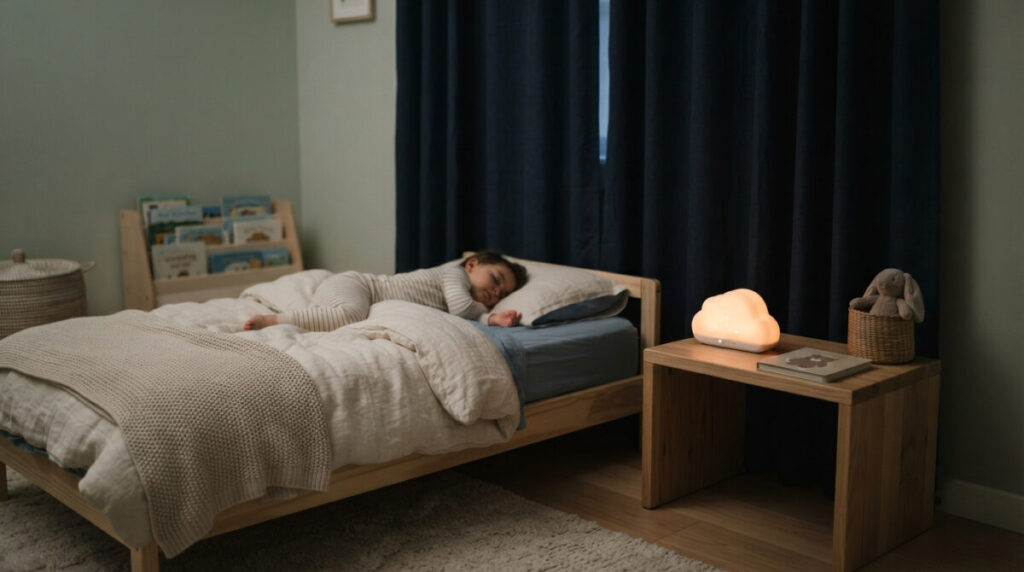
Room prep, technician style:
- Blackout curtains. Not “pretty good at blocking light.” Actually dark. A sliver of dawn light is basically a system trigger telling your kid it’s go-time.
- Remove anything climbable near windows or shelving. Assume they will use it.
- A toddler clock that changes color when it’s okay to get up. It won’t work the first week. It will, eventually, save your sanity.
Bedtime resistance is not a bug, it’s expected behavior — plan for it instead of being surprised by it every single night. Expect stalling, expect the fake “I need water,” expect the sudden emotional crisis over a stuffed animal at 8:47 p.m. Hold the line, boringly, calmly, every time.
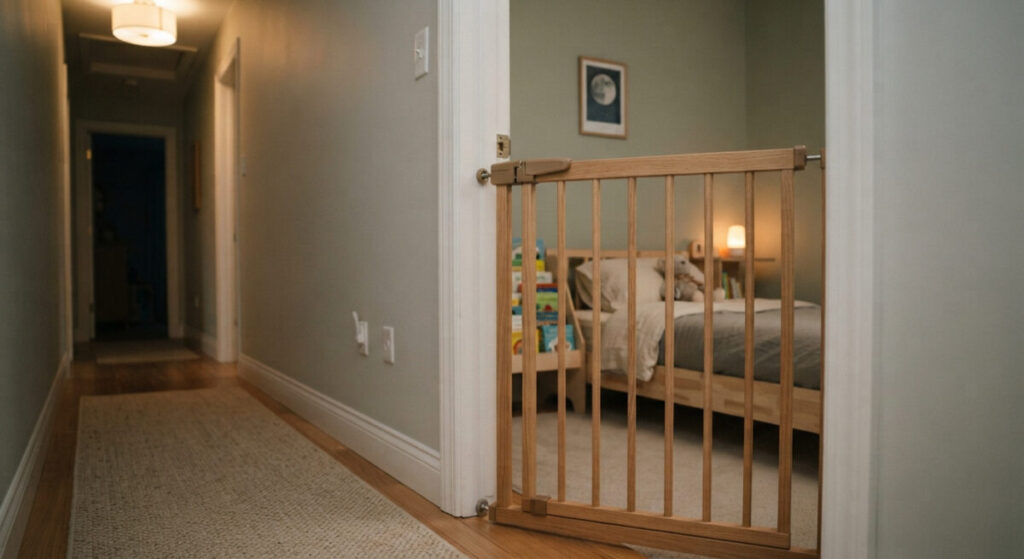
The door handle debate is real and I’m not going to pretend there’s a universal right answer. A door knob cover keeps them contained but raises fire-safety questions if they can’t get out in an emergency. A baby gate at the doorway is a solid middle ground — contains the wandering, keeps the door itself usable. Whatever you choose, think it through like the safety system it actually is, not just a parenting hack you saw online.
And please, please expect regressions. Illness, travel, a new sibling, a full moon, who knows — your kid will backslide, and it does not mean you broke something or did it wrong. Systems drift. You recalibrate. You don’t rebuild from scratch every time something wobbles.
Room prep, technician style… Blackout curtains, remove anything climbable, and keep an eye on room temperature. If your toddler is waking up restless or asking for endless drinks during warm nights, it might be a hydration issue rather than just stalling. For hot-weather tips, take a look at our guide on How to Keep Your Baby Hydrated in Summer: A Mom’s Survival Guide to keep them comfortable through the night.
You’re Doing Fine, Even When Sleep Is a Disaster
If you’re in the thick of it right now — sitting on your own dark, sticky hallway carpet, questioning your life choices at 11 p.m. — I want you to know that this part is temporary, even when it feels like the new permanent reality.
There is no clean, elegant patch for this. There’s no update you can push that makes a toddler instantly understand boundaries after moving toddler to big bed. There’s just showing up, night after boring night, being the calm, predictable, slightly exhausted constant in the room until their little brain catches up to the new setup.
You’re not failing at this. You’re debugging a very small, very stubborn, very lovable human, one weird night at a time. And eventually — I promise — the walks back to bed get shorter, the nights get quieter, and you’ll look back at the hallway carpet incident and laugh, mostly.
Mostly.