I still remember that random Tuesday when I finally gave up on the “time-out chair” and started looking for gentle discipline alternatives. My three-year-old wasn’t just crying; he was absolutely losing his mind. We’re talking about that kind of soul-piercing, window-rattling wail that makes the neighbors wonder what’s going on—all because I had the sheer audacity to cut his toast into triangles instead of the ‘required’ squares. In that moment, I knew I had to find gentle discipline alternatives that actually worked. But here’s the kicker: I did exactly what every parenting manual from the mid-90s told me to do.
Naturally, I did exactly what every parenting manual from the mid-90s told me to do. I put on my sternest face, marched him over to the corner, and delivered the classic line: “You stay here and think about what you did!” I felt like I was handing down some kind of serious punishment or something.
But here’s the thing—when I looked back two minutes later, he wasn’t reflecting on toast geometry or his “suboptimal” behavior. He was sobbing so hard he was gasping for air, looking at me with a level of terror that made me feel like a complete stranger who had just abandoned him on a desert island. But in that moment, it wasn’t just him—it broke me too. It broke me. I ended up sliding down onto the kitchen floor and crying right along with him.
I sat there wondering, Is this really what parenting is supposed to be? Just a never-ending series of mini-exiles until they finally break and listen?
That was my breaking point. I realized that for my kid, a traditional time-out wasn’t a teaching tool at all; it was just a massive wall standing between us. That’s when I started researching gentle discipline alternatives. And look, let’s get one thing straight right now: gentle parenting is not ‘permissive’ parenting. It’s not about being a doormat or letting your toddler run a fight club in the living room. It’s actually about teaching instead of just punishing. It’s messy, it’s exhausting, and if I’m being totally honest, it is way more work than just pointing to a chair in the corner. But—and this is the big “but”—it actually works.
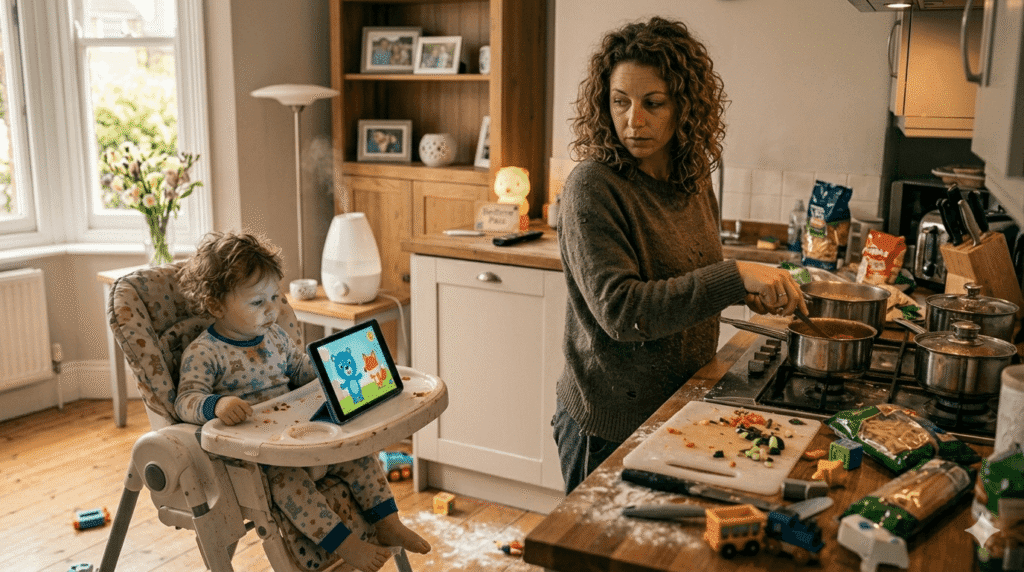
It’s messy, it’s exhausting, and some days, you just need a five-minute breather to regulate your own nervous system before you can help them with theirs. (And seriously, if that means leaning on a little Ms. Rachel to ease the screen time guilt while you drink a hot coffee, do it. You can’t pour from an empty cup.)
Why Science Favors "Gentle Discipline Alternatives" (The Flight or Fight Problem)
Why Science Favors "Gentle Discipline Alternatives" (The Flight or Fight Problem)
Here’s the deal with toddlers: their brains are essentially massive construction sites where the foreman hasn’t shown up for work yet. That part of the brain that helps with self-control and thinking things through? Wait… that’s not really online yet.
When we take a child who is already completely dysregulated and throw them into isolation, their brain doesn’t go, “Gosh, Mother makes a very valid point about my behavior.” Instead, their nervous system hits the big red panic button. They go into full “fight or flight” mode. They feel rejected, disconnected, and fundamentally unsafe.
And honestly, when a kid feels unsafe, learning just kind of… shuts off. This is why gentle discipline alternatives focus first on making the child feel safe again. Science is now showing us that what a child actually needs in those moments is “co-regulation.” They need to “borrow” our calm, adult nervous system because their own internal wiring is currently on fire.
When a child’s nervous system is stuck in survival mode, it doesn’t just affect their behavior—it drains their entire well-being. And let’s be honest, between the emotional meltdowns and building a toddler’s immunity against the daycare crud, our little ones (and we!) have enough to fight off already
The “Time-In” Strategy: Becoming the Anchor in Their Storm

If a time-out is an exile, then a “Time-In” is a heartfelt invitation. When the inevitable meltdown hits, instead of pushing them away, you actually move closer.
You might say something like, “I’m right here. I can see you’re having a really hard time right now.” You don’t need to give a grand lecture—in fact, when a kid is screaming, the less you say, the better. You’re just there with them, trying to stay calm (even if inside you’re not). You wait for the storm to pass. Once their breathing slows down and that glazed look leaves their eyes, wait, that is when the actual teaching happen. Think about it: you can’t teach a drowning person how to swim while they’re flailing in the water; you wait until you’ve pulled them back onto the sand.
5 **Gentle Discipline Alternatives** That Actually Saved My Sanity

If the chair is out, what’s in? These are the gentle discipline alternatives that ended up working for us through real-life trial and error.
Instead of turning everything into some kind of formal “method,” I just started doing what actually worked in the moment.
One thing that helped a lot was simple redirection. Like, if he was about to bang something or make a mess, I’d just quickly shift his attention somewhere else. Not in a genius way or anything — just… whatever worked at the time.
Another big one was giving him small choices. Nothing complicated. Just things like, “Do you want the blue cup or the red one?” or “Shoes on here or in the car?” And weirdly, that alone avoided a lot of meltdowns. I guess it gave him a bit of control.
And honestly, natural consequences did most of the teaching for me anyway. If something spilled, it spilled. If something broke, well… that was the result. I didn’t feel the need to turn everything into a lecture — things just kind of played out, and he figured it out over time.
We also ended up with a little “calm-down spot” at home. Not as a punishment — more like a reset place. Some pillows, a couple of soft toys… nothing special. Sometimes he’d use it, sometimes not. To be fair, I probably needed it just as much.
And maybe the biggest shift was what happened after everything calmed down. Instead of just moving on, I’d try to reconnect. Talk a bit. Keep it simple. And yeah, sometimes admit that I messed up too. Not gonna lie, that felt weird at first — but it helped more than I expected.
And let’s be real: staying calm is a lot easier in the privacy of your kitchen than it is when you’re facing a full-blown toddler meltdown at Target with a cart full of groceries and ten strangers watching you. But the principle remains the same.
A Final Pep Talk for the Skeptical (and Tired) Parent
Mama, if you tried a time-out today and it ended in a puddle of tears for Parenting isn’t about being perfect; it’s about being present. Choosing gentle discipline alternatives is just one way to stay connected even in the chaos. isn’t about being some perfect, Zen-like figure who never breaks; it’s about being present.
Some days you will be the “Zen Mama” who handles a level-10 meltdown with the grace of a monk. Other days, you’ll be the one hiding in the bathroom counting to ten while eating a granola bar just to survive.
Both versions of you are doing an incredible job. Your kid doesn’t need you to be perfect. Honestly, just showing up and not giving up most days is already a big deal. You’ve totally got this.