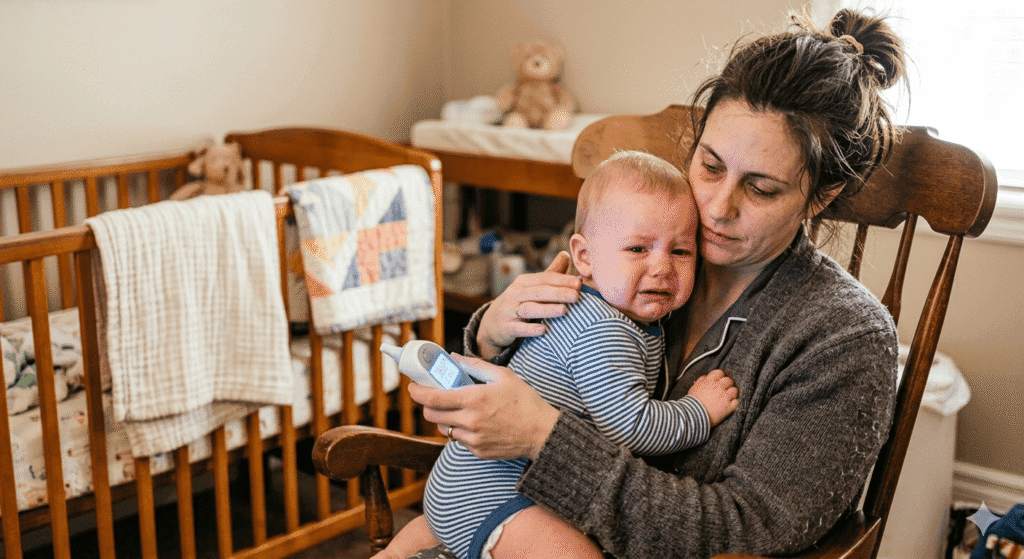
We’ve all been there. You’re in the middle of Target, your cart is half-full, and suddenly your sweet little angel is a screaming puddle on the floor. In that high-stress moment, every mom frantically wonders what to say during a toddler tantrum to make it stop without losing her cool. The stares from strangers start, your face gets hot, and you feel that familiar wave of Mom Guilt washing over you. I remember one time mine did this right next to the checkout line—of course, right when everyone was watching. Of course. Right when everyone was watching. I just stood there holding a pack of wipes like… cool, cool, this is my life now.
Quick Scripts: What to Say to a Screaming Toddler If you are in the middle of a meltdown right now, try these three phrases:
- “I see you are having a very hard time, and I am right here with you.” (Validation)
- “It’s okay to be mad, but it’s not okay to hit. I’ll help you stay safe.” (Boundaries)
- “I’m going to sit here and keep you company until you’re ready for a hug.” (Connection)
The stares from strangers start—you know that “look,” the one that says Can’t she control her kid? Your face gets hot. You feel that familiar wave of Mom Guilt washing over you, followed closely by the soul-crushing weight of Burnout. And you’re just standing there thinking… okay, what am I even supposed to say right now?
Honestly? I’ve been exactly there. My living room looked like a battlefield just this morning because I had the audacity—the nerve!—to peel a banana ‘the wrong way.’
A quick note for the rough days: Parenting has so many different “seasons.” Whether you’re dealing with tantrums, or currently stuck in the middle of winter colds and cabin fever, I’ve got your back. If you’re finding the colder months particularly tough, check out The Ultimate Winter Survival Guide for Toddlers: Dry Skin, Colds, and Cozy Indoor Play for some extra peace of mind.
It doesn’t mean you’re failing, by the way. You’re just dealing with a toddler brain, and let’s be real—it’s a wild place to be.
It also helps to remember that a toddler’s brain is highly sensitive to how their body feels. If they’re fighting off the latest preschool cold, their fuse is going to be ten times shorter. If you’re constantly battling the ‘nursery plague’ while trying to stay calm, you’ll definitely want to read The Daycare Crud: How to Build Your Toddler’s Immunity (Without Living in a Bubble) for some practical ways to strengthen their system from the inside out.
The Science: It’s Biology, Not Bad Behavior (I Promise!)
What actually helped me was understanding what’s going on in that tiny, screaming head. It helps to remember this when you’re about to lose your cool.
I started thinking of their brain like a little house. The downstairs is the Amygdala—the emotional center. It’s responsible for “fight or flight.” The upstairs is the Prefrontal Cortex—the part that handles logic, reasoning, and, you guessed it, staying calm.
Sometimes, that biology is fueled by what’s in their sippy cup, too. If you’re navigating the confusing world of toddler nutrition while dealing with these outbursts, you might want to check out my deep dive on Is Toddler Milk a Marketing Scam? The Truth About Formula vs. Whole Milk to make sure their brain is getting the right fuel without the extra sugar.
When a toddler has a meltdown, the “downstairs” brain has completely taken over. The “upstairs” brain has literally left the building. You can’t reason with them in that moment. I tried. It doesn’t work. This is why explaining why the banana had to be peeled that way is useless. At that point, you’re not trying to win an argument—you’re just trying to help them calm down enough to think again.
My Mom-to-Mom Moment: I remember one time my son decided he needed to wear two different shoes—one rain boot and one flip-flop—to a formal family dinner. I tried logic. I tried bribes. I tried the “Prefrontal Cortex” talk. Nothing. He hit the floor like a sack of potatoes. In that moment, I realized: his “upstairs house” was empty. There was nobody home to listen to reason. Once I stopped talking and just sat on the floor with him, the storm started to pass. Knowing what to say during a toddler tantrum often starts with knowing when to stop talking logic to a person who has none.
Once I stopped talking and just sat on the floor with him, the storm started to pass. Knowing what to say during a toddler tantrum often starts with knowing when to stop talking logic to a person who has none.
What to Say During a Toddler Tantrum (Real-Life Scripts That Help)
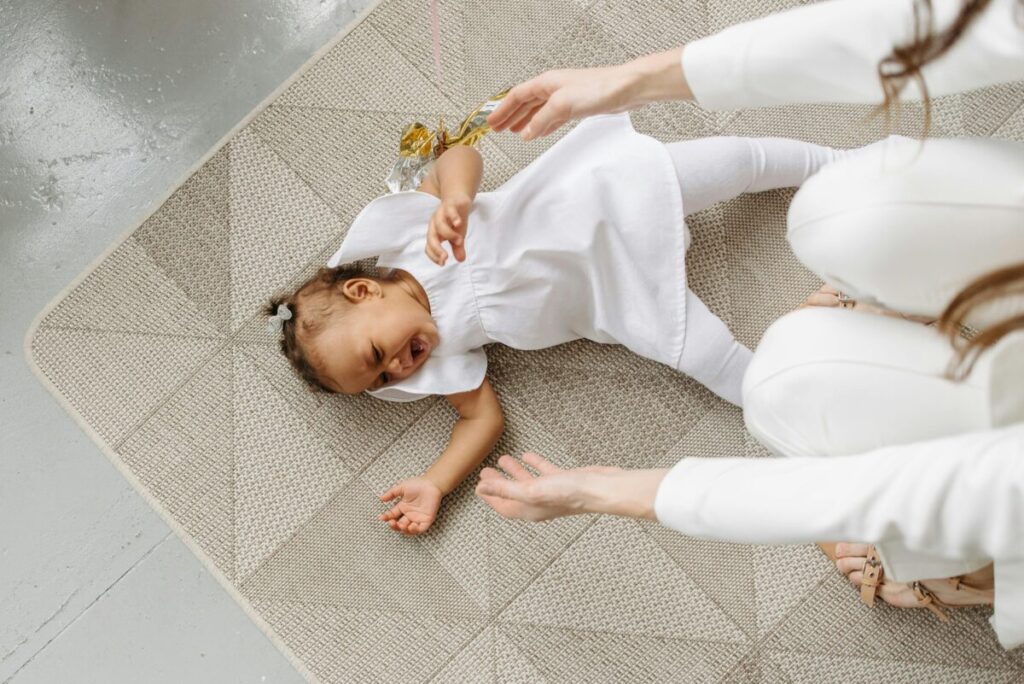

When you’re wondering what to say during a toddler tantrum, what actually helps is just letting them feel heard. You aren’t agreeing with the behavior (we aren’t saying it’s okay to kick the cat); you’re acknowledging the emotion behind it. This is what I’ve found myself saying in different situations:
1. What to Say When a Toddler is Overstimulated
When you’re deciding what to say during a toddler tantrum triggered by sensory overload, remember that less is more. Their system is just full.
- “I see you are having a hard time, and I am right here.”
- “Everything feels very loud/big right now. Let’s find a quiet spot together.”
- “It’s okay to feel overwhelmed. I’ll stay with you until you feel safe.”
Honestly, sometimes the best thing you can say is barely anything at all. When my son is spiraling because the TV was too loud or the room was too crowded, I just get low and whisper, “I’ve got you.” It’s like an anchor in their storm.
2. How to Respond When They Are Angry at a Boundary
This is the classic ‘I want to eat the battery’ or ‘I want to jump off the fridge’ tantrum. When safety is at risk, knowing what to say during a toddler tantrum becomes even more critical because you have to be firm on the boundary but soft on their big feelings.
- “You really wanted to do that, and it’s frustrating that you can’t. I hear you.”
- “It’s okay to be mad that I said no. I’m keeping you safe because I love you.”
- “You’re allowed to be angry, but I won’t let you [hit/kick]. I’ll hold your hands until you can be gentle.”
3. When They Just Need to “Cry It Out”
Sometimes, there is no ‘fix.’ They just have a big ball of emotion that needs to come out. Maybe the blue cup was in the dishwasher. Maybe the sun is too bright. At moments like this, knowing what to say during a toddler tantrum is about acceptance, not solutions. Here is how I handle those ‘big ball of emotion’ moments.
- “I’m right here if you need a hug. If you just need to cry, that’s okay too.”
- “I see those big feelings. You’re safe with me.”
- “I’m going to sit right here and keep you company while you feel sad.”
Handling Toddler Meltdowns: What NOT to Say


We’ve all snapped. I’ve definitely been the mom yelling “BE QUIET” while trying to teach my kid to be quiet (the irony is not lost on me). But if you want to know what to say during a toddler tantrum to actually de-escalate things, try to avoid these common traps:
- “Stop crying!” (Imagine being devastated and someone tells you to just stop. It makes the emotion bigger.)
- “Calm down!” (Toddlers don’t know how to calm down yet. That’s a skill we are teaching them.)
- “You’re being a bad boy/girl.” (Label the behavior, never the child. They aren’t bad; they’re struggling.)
- “I’m going to leave you here if you don’t stop.” (This triggers abandonment fears and sends the amygdala into overdrive. It works in the short term, but it damages trust in the long term.)
And let’s be real—sometimes the meltdown isn’t just about the words we use, it’s about the sugar crash they’re experiencing. If you feel like your toddler’s moods are on a roller coaster, you’ll find my guide on The Sugar Struggle: Navigating Treats, Tantrums, and Healthy Boundaries for Toddlers incredibly helpful for setting those tricky food boundaries.
Calming a 2 Year Old Tantrum: The Power of Silence and Spaghetti


Sometimes, the best answer to what to say during a toddler tantrum is… nothing at all.
I’ll never forget the “Spaghetti Wall Art” incident. I had spent an hour making this healthy, veggie-loaded sauce. He took one look, screamed “NO RED,” and launched the bowl at the wall. I was ready to roar. But instead, I looked at the sauce dripping down the beige paint, looked at his red-faced fury, and I just… sat down. I didn’t say a word. I breathed. After a minute, he crawled into my lap, still sobbing.
If you’ve offered validation and they are still screaming, your ‘upstairs’ brain needs to stay calm to act as an anchor for theirs. Sometimes, sitting quietly on the floor near them—not hovering, just being—is the strongest script you have. It says, ‘Your big emotions don’t scare me, and they won’t push me away.’ When you’re struggling with what to say during a toddler tantrum, remember that sometimes your calm presence speaks louder than any words ever could. That’s usually the only thing that keeps me from losing it.
More Toddler Meltdown Tips for Staying Sane
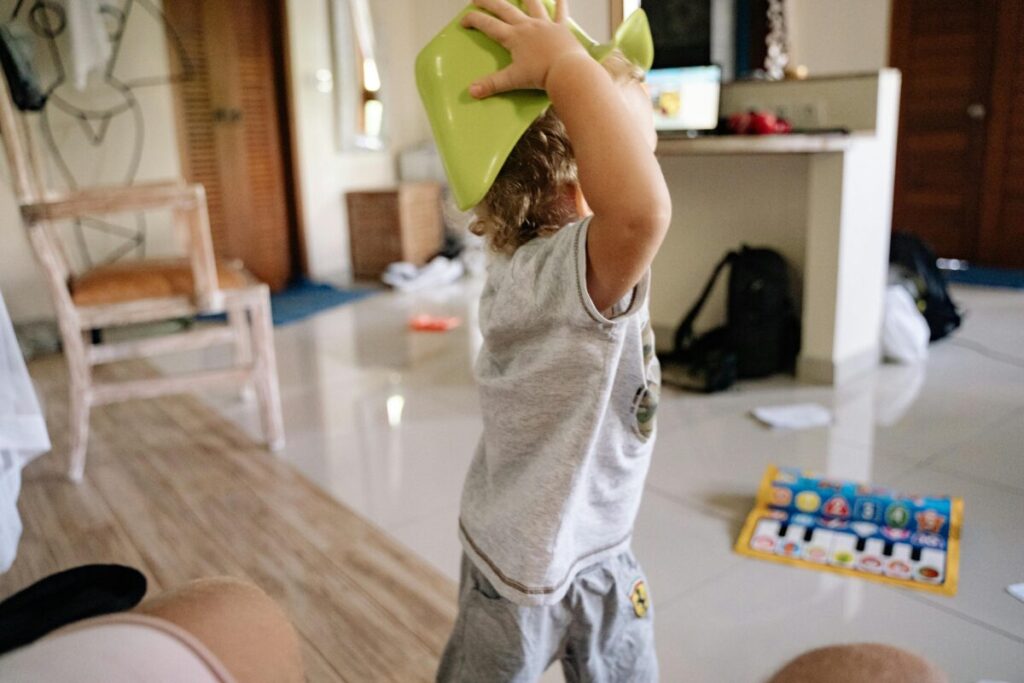

Let’s be honest for a second. It is incredibly hard to be a “gentle parent” when you’ve had four hours of sleep, the house smells like old milk, and you’re on your third cold cup of coffee. The truth is, they calm down faster when we don’t lose it… and yeah, that’s the hard part.
And if you feel like you’re about to lose it (been there), here’s what actually helps:
- Tag out: If a partner is home, say “I need five minutes” and walk away.
- The “Safety Check”: If you’re alone, make sure your toddler is in a safe spot (like their crib or a child-proofed room) and go into the bathroom. Splash cold water on your face. Scream into a towel. It’s better to walk away for a minute than to stay and escalate.
- Lower your expectations: On “Tantrum Days,” dinner can be cereal. The laundry can stay in the dryer for the third day in a row. Your mental health matters more than a folded t-shirt or a gourmet meal.
The “After the Storm” Phase: Reconnecting
This transition is just as important as knowing what to say during a toddler tantrum, because it’s where the actual learning happens.
Once the screaming stops and the shaky “after-sobs” begin, This is where things actually start to shift. This is when the “upstairs brain” comes back online and they are actually ready to learn.
- The Hug: Ask, “Do you need a squeeze?” Physical touch releases oxytocin and lowers stress levels for both of you.
- The Debrief: “You were really mad about that banana, weren’t you? It’s hard when things don’t go the way we want. I love you no matter what.”
- The Clean-up: If things were thrown (looking at you, spaghetti), help them clean up together. It’s not a punishment; it’s restoring the environment and showing them how to fix mistakes.
How to Handle Toddler Meltdowns: A Survival Guide for Moms


When you find yourself googling what to say during a toddler tantrum at 2:00 AM while nursing a headache, remember this: Weirdly enough, when they fall apart like that—it usually means they feel safe with you. That is actually a sign of a secure attachment, even if it feels like a nightmare in the moment.
They aren’t “giving you a hard time,” they are having a hard time.
Even on the messy days… you’re still showing up. And that counts. Even on the days when you don’t use the perfect script. Even on the days when you lose your cool and hide in the pantry to eat chocolate. Even in those messy moments—you’re still their safe place.
So, the next time you’re desperately wondering what to say during a toddler tantrum while standing in a public aisle, remember: you are their safe place
Now… if your coffee is cold again, same.
Knowing what to say is the first step, but changing how we handle discipline as a whole is where the real transformation happens. If you’re ready to ditch the old-school punishments for something that builds a stronger bond, definitely read my journey on Moving Beyond the Naughty Chair: Why I Finally Trashed Time-Outs for a Discipline That Actually Sticks.
FAQ: Frequently Asked Questions About Toddler Tantrums
How long do tantrums last?
Most toddler tantrums last between 2 to 15 minutes. However, it can feel like three hours when you’re in a public place! If you are consistently wondering what to say during a toddler tantrum because they last longer than 25-30 minutes, it’s worth mentioning to your pediatrician.
At what age do tantrums peak?
Tantrums usually peak between the ages of 2 and 3 (the “Terrible Twos” and “Threenage” years). This is when their desire for independence is high, but their communication skills are still catching up.
When to worry about tantrums?
While tantrums are a normal part of emotional regulation for toddlers, you should talk to a professional if:
- The tantrums are violent (hurting themselves or others) frequently.
- They happen many times every single day.
- Your child never seems to “recover” or return to a happy state afterward.
- You feel like you cannot safely manage them.
Does “giving in” make tantrums worse?
Generally, yes. If a child learns that a tantrum results in getting the “forbidden” item, they will use that tool again. Stay firm on the boundary (“No, we aren’t buying that toy today”), but stay soft on the emotion (“I know it’s disappointing”). This is the core of handling toddler meltdowns.
What to say during a toddler tantrum when in public?
Honestly, same thing applies. Just focus on your kid, not the people staring. Your priority is your child, not the comfort of strangers. A simple, “I’ve got you, we’re going to go to the car to finish our big feelings” is a great way to exit a situation gracefully.
Disclaimer
The information provided on Tiny Care Tips is for educational and informational purposes only and is not intended as medical or professional advice. While I share my personal experiences and research as a parent and content creator, I am not a doctor, child psychologist, or licensed therapist. Always seek the advice of your pediatrician or other qualified health provider with any questions you may have regarding a medical condition or your child’s emotional and behavioral development. Never disregard professional medical advice or delay in seeking it because of something you have read on this website.