
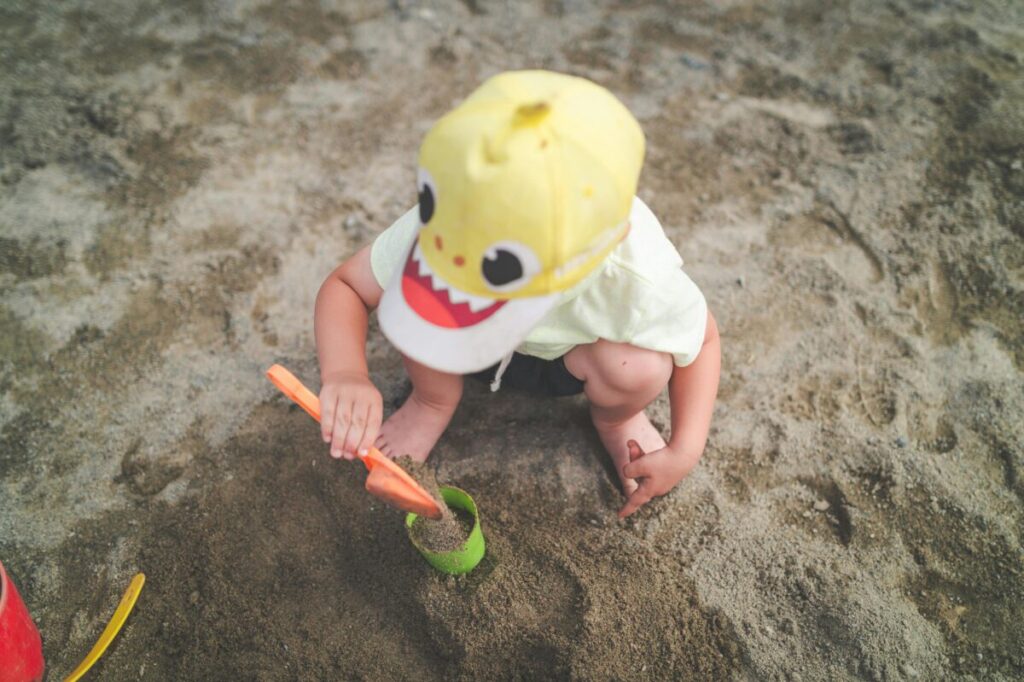
There’s a specific kind of shame that washes over you at the playground. You know the one. Your toddler has just snatched a shovel out of a smaller kid’s hands, the smaller kid is wailing, and every parent within a ten-foot radius has gone very quiet. You scramble over, doing that tight-lipped smile that says I promise I’m a good mother, while your child clutches the shovel like it’s a sacred relic and screams — full volume, no hesitation — “MINE.” We’ve all been in the middle of these intense toddler sharing struggles, feeling like every eye is on us, waiting to see if we’ll “fix” it.
And you just stand there. Wanting to dissolve into the wood chips.
I’ve been there more times than I can count. My son Eli was around two and a half when I hit what I now call peak playground panic. At home, he was honestly such a sweet kid. He’d kiss the dog on the nose, bring me random blankets if I sneezed, and say “you okay, Mama?” in this tiny serious voice. But at the playground? Completely different story sometimes.
The second another kid even looked at a toy he was using, it was like a switch flipped. Suddenly he was clutching a plastic shovel like his entire future depended on it. Teaching toddlers empathy in those moments felt less like gentle parenting and more like trying to negotiate with a tiny drunk lawyer who might also bite somebody.
I tried everything I could think of. Calm voice. Firm voice. Redirection. Counting to three. Snacks. Bribing with crackers at one point, honestly. Nothing really seemed to work for a while, and after some park trips I’d drive home feeling completely defeated, replaying every interaction in my head wondering if I was somehow messing him up.
One night — I think it was around 3 AM — Eli had woken up crying again, and after finally getting him back to sleep, I just laid there staring at the ceiling feeling exhausted and sorry for myself. I remember scrolling on my phone and reading something that said: “He’s not giving you a hard time. He’s having a hard time.”
And I don’t know why, but that hit me differently that night. Because if I’m being really honest, up until then I think part of me felt like his behavior was happening at me. Like he was choosing to embarrass me in public or choosing to make everything harder. But he wasn’t. He was overwhelmed a lot of the time. By noise, by frustration, by waiting, by big feelings he didn’t know what to do with yet—whether it was pushing back at the playground, or digging his heels in during other developmental battles like [Potty Training Resistance: What to Do When Your Toddler Refuses the Toilet], where they suddenly want to control every single aspect of their routine.
And I don’t know why, but that hit me differently that night.
Because if I’m being really honest, up until then I think part of me felt like his behavior was happening at me. Like he was choosing to embarrass me in public or choosing to make everything harder. But he wasn’t. He was overwhelmed a lot of the time. By noise, by frustration, by waiting, by big feelings he didn’t know what to do with yet.
And once I started seeing it that way, things didn’t magically get easier overnight — but I reacted differently. And honestly, that changed a lot.
That realization didn’t fix anything overnight. But it changed the lens. And the lens matters more than any specific strategy.
Your Toddler’s Brain Is Not Broken. It’s Just Young.
One thing I really wish someone had explained to me earlier is that toddlers genuinely do not have the self-control skills we expect from them yet. Like… their little brains are still developing so much. The part responsible for impulse control, emotional regulation, and “thinking before acting” is nowhere near fully developed at this age. This is why toddler sharing struggles are so common; they aren’t being stubborn, they’re just waiting for their brains to catch up to the social expectations we’re placing on them.
So when Eli grabbed that shovel at the playground, it wasn’t some calculated decision to be mean. He wasn’t standing there thinking, “I know this will upset that kid and I don’t care.” His brain basically just went: I want that. And his body reacted before anything else could catch up.
That realization honestly helped me calm down a little.
Because toddler sharing struggles don’t automatically mean you’ve raised a selfish kid. They’re not proof you’re failing as a parent. They’re just part of being two. Toddlers are impulsive. They get overwhelmed fast. They struggle with waiting, sharing, transitions — all of it. It’s incredibly normal, even if it feels mortifying when it happens in public.
And trust me, I know it still feels embarrassing when your child is the one causing the scene at the park while every other parent suddenly goes quiet.
But understanding what’s actually happening developmentally helped me stop viewing every meltdown or grabbing incident as some huge parenting failure.
The hard part is that there isn’t a quick fix for teaching empathy. It’s not one magical conversation where suddenly they start sharing perfectly and using kind words all the time. It’s repetition. Tiny moments over and over again. Reminding, modeling, practicing, repairing — constantly.
And honestly? Some days it feels like absolutely none of it is working.
But that doesn’t mean you’re failing. That’s just what teaching toddlers looks like sometimes.
The Shovel Incident, and What I Did Wrong

Let me tell you what I used to do.
Another kid would be crying because Eli had something they wanted, or Eli would be crying because another kid had something he wanted, and I would panic. I’d grab the toy. I’d say “we share, we have to share” in that strained cheerful voice that fools nobody. I’d do the forced hand-over and spend the next twenty minutes managing Eli’s meltdown while internally replaying the whole thing. Looking back, I realize that what I was doing was the exact opposite of gentle discipline for toddlers; I was forcing compliance rather than teaching a skill.
The thing is — that doesn’t teach sharing. It teaches compliance under pressure. It teaches that things get taken away without warning when adults decide it’s time. Which, if you think about it from a toddler’s perspective, is terrifying and arbitrary. Of course they resist it.
Genuine teaching of empathy and sharing looks completely different, and it’s slower, and it feels awkward at first because it requires you to narrate out loud in front of other parents like some kind of educational documentary.
The thing that actually changed our park experiences was dropping the word “share” almost entirely and replacing it with “turns.” Turns is concrete. It has a start and an end. There’s something in it for the kid who’s waiting, because their turn is actually coming.
Instead of: “You need to share. Give Mia the truck right now.”
Try: “Eli has the truck right now. When he’s done, it’s Mia’s turn. Mia, can you pick something else while you wait for your turn?”
It sounds minor. It’s not. What you’re doing is validating that Eli’s current use of the truck is legitimate — he had it first, he gets to finish — while also setting the clear expectation that Mia will get it next. Nobody gets surprised. Nobody gets ambushed. And Eli isn’t learning that toys get snatched away whenever a grown-up decides, which means he’s slightly less likely to death-grip everything in a five-foot radius out of preemptive self-defense. This is exactly how to set boundaries with toddlers without causing a power struggle—you’re being predictable, firm, and respectful all at once, which is the key to finally overcoming those daily toddler sharing struggles.
The other thing that helped enormously was a simple countdown. “You have ten more seconds with the truck, then it’s Mia’s turn. Ten… nine… eight…” It sounds tedious. It kind of is. But it gives them the end coming as information instead of a shock. They feel the transition happening instead of being ambushed by it, and ambush is what triggers the full nuclear meltdown.
About the Hitting. And the Biting. (Yes, the Biting.)
I want to talk about this because it almost broke me and nobody warned me how bad it would get.
Eli went through a biting phase when he was around 22 months. Not one or two incidents — an extended phase where he bit when he was frustrated, when he was overstimulated, when he was tired, when he was excited. He bit me, he bit my husband, he bit a kid at playgroup and I had to make a phone call I still cringe thinking about.
I had read enough about gentle discipline for toddlers to know I wasn’t supposed to bite him back, wasn’t supposed to shame him, or make it a huge dramatic production. But here is the thing about that advice that none of the Instagram posts prepare you for: knowing the “right” response and actually executing it calmly when your child has just left teeth marks in your forearm are two completely different things. My whole body wanted to react. I was holding back a reaction with everything I had.
What eventually worked — and I mean eventually, after weeks of inconsistency — was keeping my response flat. Not cold, not cruel, just… unremarkable. I’d make eye contact, move him back, and say quietly: “I won’t let you bite me. Biting hurts. I’m going to move away.” Then I’d physically put space between us. No lecture. No long explanation. Just the boundary and the consequence, immediate and clear.
The thing about biting, and hitting too, is that for a lot of toddlers the big emotional reaction from you is interesting to them. Not because they’re manipulative — they’re two, they’re not plotting anything — but because they’re still figuring out cause and effect, and “I did this and mom made that face and that loud sound” is genuinely fascinating to a toddler brain. A flat, consistent response removes the interesting part.
How to set boundaries with toddlers isn’t really about having the perfect script. It’s about doing the same thing every single time until their brain starts to predict it. Predictable is boring. Boring doesn’t get repeated as often.
And look — you’re not going to stay calm every time. I didn’t. I still don’t. One morning Eli kicked me in the shin during a shoe argument and I said something under my breath that I absolutely cannot repeat here. That’s okay. You repair it, you move on, you try again. The overall pattern matters more than any single moment.
The Part Nobody Talks About: Validating Before Redirecting



There was this phase where Eli would lose it over things so small that my first instinct every single time was to either laugh or get annoyed. The wrong color cup. A cracker that broke in half. A sock that felt “weird.” The fact that the sun was in his eyes. Once, memorably, he collapsed onto the kitchen floor because I gave him his milk and he’d wanted to carry the milk himself. Learning to handle these irrational meltdowns with grace is the real heart of gentle discipline for toddlers.
My instinct in all of these moments was to fix it, or to talk him out of it, or to point out that it wasn’t a big deal. None of that worked. Every time I tried to logic my way through a toddler meltdown I just made it last longer.
What actually worked was stupidly simple and felt almost too easy the first time it helped: I’d just name what was happening before I did anything else.
Not “stop crying, it’s just a cracker.” Not “okay okay okay, here’s a new cracker.” Just: “You’re really upset. That cracker broke and you didn’t want it to break. That’s really frustrating.”
That’s it. Sit with it for a second. Don’t rush to fix.
What I started to notice was that when Eli felt like I’d seen what he was feeling, he’d de-escalate faster. Not always, not instantly, but faster than when I tried to problem-solve immediately. Because here’s the thing about teaching toddlers empathy that I really came to understand over time: it starts with them feeling empathized with. If you want your kid to recognize other people’s emotions and respond to them, you have to model what that looks like. And you can start right now, with their own emotions, in the middle of the kitchen floor over a broken cracker.
You’re not teaching them that the cracker breaking was a tragedy. You’re teaching them that feelings are real, that feelings have names, that someone can hear you having a feeling and stay calm about it. That’s the whole foundation.
What This Actually Looks Like in Practice
I want to be specific here, because vague parenting advice drives me absolutely crazy. “Model empathy.” Okay, but what do I say when my kid is mid-meltdown in a parking lot?
Here’s what I mean when I say narrate emotions:
When Eli grabbed something from another kid, instead of just correcting the behavior, I’d point at the other kid’s face: “Look at Jake’s face. He looks sad. He was using that and now he’s sad that it’s gone.” Not a lecture. Not a guilt trip. Just — look. There’s a face. The face means something. It’s one of the most effective ways of teaching toddlers empathy, because it turns a abstract concept into something they can actually see.
When he’d hit me, after I’d set the boundary, I’d say: “You were so frustrated. You wanted that and I said no and that felt awful.” Not approving the hitting. But naming what was underneath it.
When he saw a kid fall down at the park, I’d say: “Oh, she fell. Do you think she’s okay? What does her face look like?” Teaching him to look, to notice, to read.
These are tiny. They don’t feel like they’re doing anything. But they’re building something — a habit of looking at other people, a vocabulary for emotions, a sense that feelings are real and connected to behavior.
The scripts that worked for us, in actual situations:
When he grabbed a toy: “Oh, she was using that. Let’s give it back and find you something else — I’ll help you look.” (Moving toward something instead of just taking away.)
When he hit out of frustration: “I see you’re really upset. Hitting hurts me. Can you tell me what’s wrong with words? I’m listening.”
When he wouldn’t wait: “Waiting is so hard. It really is. Almost your turn — let’s count.”
When he saw another child crying: “She’s crying. I wonder what happened. Should we check on her?”
None of these are magic. All of them require patience you sometimes don’t have. But they’re real, and they work over time.
The Signs It’s Actually Working (They’re Easy to Miss)


Progress with toddlers is so quiet. It doesn’t look like a breakthrough. It doesn’t announce itself.
It looks like the morning Eli stubbed my toe with his scooter by accident and said, unprompted, “you okay, Mama?” in this tiny concerned voice that made me want to cry in the grocery store parking lot. It’s in these small, quiet moments that I realize that the messy, imperfect process of teaching toddlers empathy is actually working.
It looks like the afternoon he handed a toy to a baby at a music class without being asked. Without even looking at me for approval — he just did it.
It looks like the moment at the park, maybe eight months after the shovel incident, when another kid reached for something Eli was using, and instead of grabbing it back Eli looked at me and said, “my turn? Then her turn?”
He was three years and two months old. He still had meltdowns. He still had hard days. But something in there was building.
The progress happens in these almost invisible moments — them pausing a half-second before grabbing, them noticing without being prompted that someone nearby is upset, them using a feeling word out loud that you didn’t know they knew. Celebrate these moments. Actually celebrate them. Tell them what you saw. “I noticed you waited your turn back there. That was really kind. I saw that.” This kind of positive reinforcement is a cornerstone of gentle discipline for toddlers; it shows them that you see their hard work and encourages them to keep choosing kindness.
Because what we’re doing — all of this narrating and scripting and repeating — is building a kind of emotional literacy. Slowly, clumsily, imperfectly. But it’s building.
Related Reading
If you are looking for more practical strategies to handle the challenges of toddlerhood, you might find these guides helpful:
- What to Say During a Toddler Tantrum: Scripts That Actually Work (and Keep You Sane) – Learn the exact phrases to use when emotions run high.
- The Toddler Dinner Battle: How to End the “No Veggies” War Without Losing Your Mind – End the mealtime power struggles with these simple, effective tips.
- The Mental Load: Why You’re Exhausted Even When Your Baby Sleeps – An honest look at why parenting is so draining and how to start protecting your energy.
- The Crib to Bed Transition: How to Move Your Toddler Without Losing Your Mind – Practical tips to make the big transition from crib to bed as smooth as possible.
Mama-to-Mama: You’re In It, and That’s Enough
The fact that you’re reading about teaching toddlers empathy — at whatever hour this is, wherever you are, probably with cold coffee nearby — means you’re already doing the work. You’re thinking about it. You’re trying. That matters more than getting every single interaction right.
The playground shame is real. The exhaustion is real. The frustration of feeling like you’re saying the same things five hundred times and nothing is changing — that’s real too. And the pressure to have a toddler who performs good social behavior in front of other parents, who shares on command and doesn’t hit and says sorry and means it — that pressure is enormous and mostly invisible and it makes this whole thing so much harder than it needs to be.
Your kid doesn’t need to perform empathy. They need to slowly, gradually, over years, actually develop it. And that process is not linear. It’s not photogenic. It involves a lot of parking lot meltdowns and embarrassing moments and days where you do everything right and nothing works anyway.
But you keep showing up. You keep naming feelings and narrating emotions and holding boundaries with as much warmth as you can manage. You keep getting back down to their level after you’ve lost your patience. You repair the moments that didn’t go well. You try again. Learning how to set boundaries with toddlers isn’t about being perfect—it’s about being consistent and showing up, even when it’s hard.
That’s not falling short of good parenting. That is good parenting.
They’re learning. You’re learning. And honestly — a toddler with a parent who’s genuinely trying to understand them, who sees them as a small person having a hard time rather than a problem to manage, who keeps showing up even when it’s exhausting? That kid is going to be okay.
You’ve got this, mama. Even on the shovel days.