
Are you staring at your twenty-month-old right now, wondering why on earth they suddenly turned into a tiny, screaming toddler dictator overnight? Did they just learn the word “No!” and decide to make it their entire personality, or are they completely melting down because you cut their toast into triangles instead of squares? If you’re hitting these exact roadblocks, welcome to the wild world of 20 month milestones.
If you’re googling things like “why is my 20 month old suddenly so angry?” at 2 AM while lying in bed questioning every parenting decision you’ve ever made, first of all — take a breath. This stage is really common, even if it feels completely chaotic when you’re living through it.
Around this age, toddlers suddenly want independence for absolutely everything… but they still don’t really know how to handle frustration, waiting, disappointment, or big emotions yet. So the result is usually a lot of very loud opinions, dramatic reactions, and meltdowns that seem to appear out of nowhere.
So if your coffee has been reheated three times already today, honestly… same. And if you’re reading this while hiding in the bathroom for two minutes of quiet because your toddler has been yelling since breakfast, I get it.
Around the time you hit 20 month milestones, things start changing fast. Your little baby suddenly has very strong opinions about absolutely everything, endless energy, and the emotional stability of someone who skipped their morning nap and taxes at the same time.
One minute they’re laughing hysterically because the dog sneezed, and the next they’re on the floor crying because you gave them the banana they literally asked for thirty seconds ago.
And honestly, the hardest part is that half the time you’re just trying to figure out what triggered the meltdown in the first place. Was it the wrong cup? The fact that you opened the granola bar “too much”? Did you walk into the kitchen without them? Nobody knows. Sometimes not even the toddler knows.
This stage can feel loud, messy, overstimulating, and weirdly funny all at the same time.
But beneath the messy, chaotic surface of our daily survival routines, some truly incredible developmental leaps are happening right now. Tracking 20 month milestones isn’t about checking off rigid, stressful boxes in a medical textbook; it is about understanding the massive cognitive, physical, and emotional updates happening inside that tiny, beautiful, and loud brain. Your little one is actively trying to figure out where they end and where the rest of the world begins. Let’s dive into what is actually going on behind those intense little eyes this month and how we can survive the daily madness with our sanity intact.
The Tiny Dictator Phase: 20 Month Old Boundary Testing Behavior
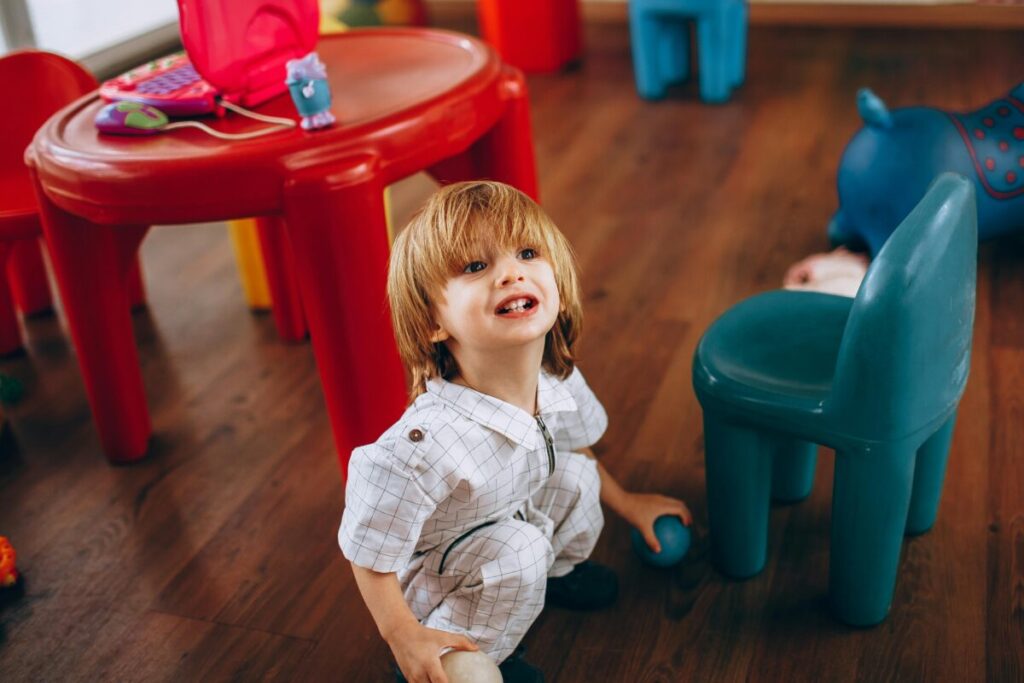


If your toddler’s favorite word lately is “NO!” screamed directly into your face, welcome. You’re definitely not the only one living through this stage right now.
Around twenty months, toddlers suddenly start having really big opinions about everything. They want to choose the spoon, open the door themselves, press every button, climb everything, and somehow do all of it immediately.
The hard part is that they understand way more than they can actually communicate. So they know what they want, but they can’t always explain it clearly yet. And honestly, that frustration builds up fast for both of you sometimes.
You might notice a sudden, exhausting surge in what experts call 20 month old boundary testing behavior. I need you to repeat after me: This isn’t malice, even if it feels incredibly calculated and personal when you are running on four hours of broken sleep. It is a necessary, healthy psychological experiment. Your toddler is essentially running a daily lab report, asking: “What happens if I do this? Is my mom still going to keep the world safe and predictable if I push against her rules with everything I’ve got?”
Literally the other day, my toddler picked up this giant plastic dinosaur and held it right over the coffee table while staring straight at me. And I already knew. You know those moments where you can physically feel a bad decision coming?
I did the calm mom voice thing anyway. “Please don’t throw that on the table, okay?”
He paused for a second, looked directly into my soul, smiled a little… and dropped it anyway.
And honestly? I was immediately irritated. Not even in a calm, gentle-parenting way. Just regular exhausted-mom irritated. Because in that moment it feels personal, like they heard you perfectly and chose chaos anyway.
If you find that these moments are happening more often and leaving you feeling frayed, Touched-Out and Overstimulated: 10 Real-Life Coping Strategies for the Exhausted Mom offers some great tools for managing that sensory overload.
But toddlers at this age do this constantly. They push the boundary just to see what happens next. Not because they’re “bad,” but because their brains are trying to figure out how the world works, what the rules are, and whether those rules stay the same every time.
When you are dealing with this intense 20 month old boundary testing behavior, consistency is your absolute best friend, even when you are too tired to care. Toddlers crave predictability; it makes their chaotic world feel stable. When they push a boundary, they are actively looking for the wall. If the wall moves, or if it disappears because we react differently every time out of pure exhaustion, they will just keep pushing harder and harder to find out where the real limit lies. Acknowledge the big feeling, hold the boundary firmly but kindly, and remember that this exhausting behavior is actually a sign of a healthy, curious mind discovering its own independence.
Stepping Back: How to Encourage 20 Month Old Independent Play

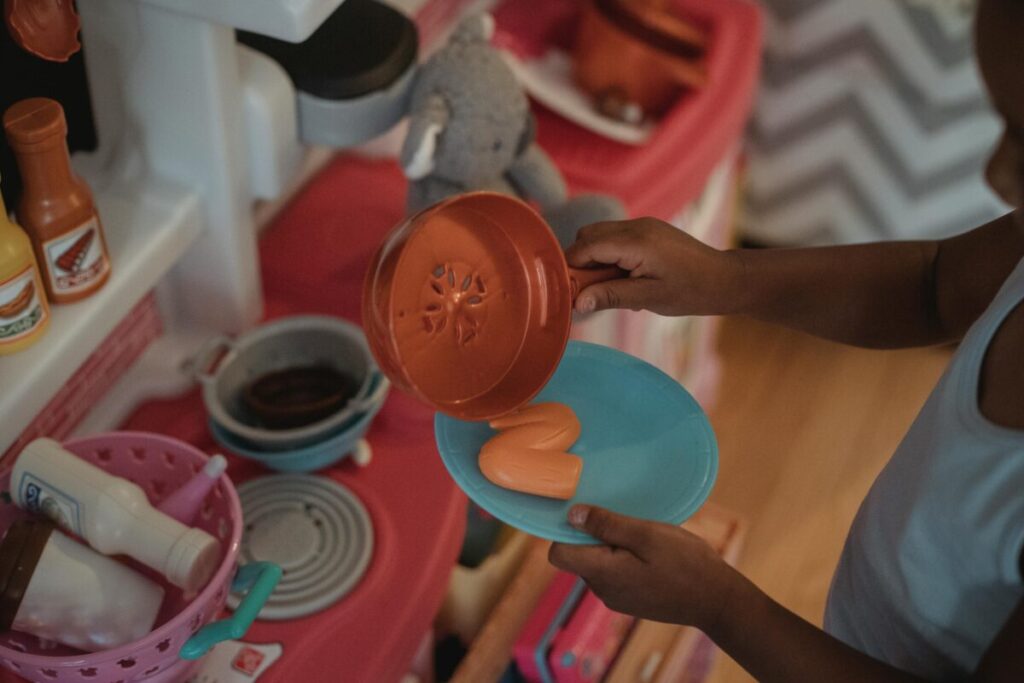
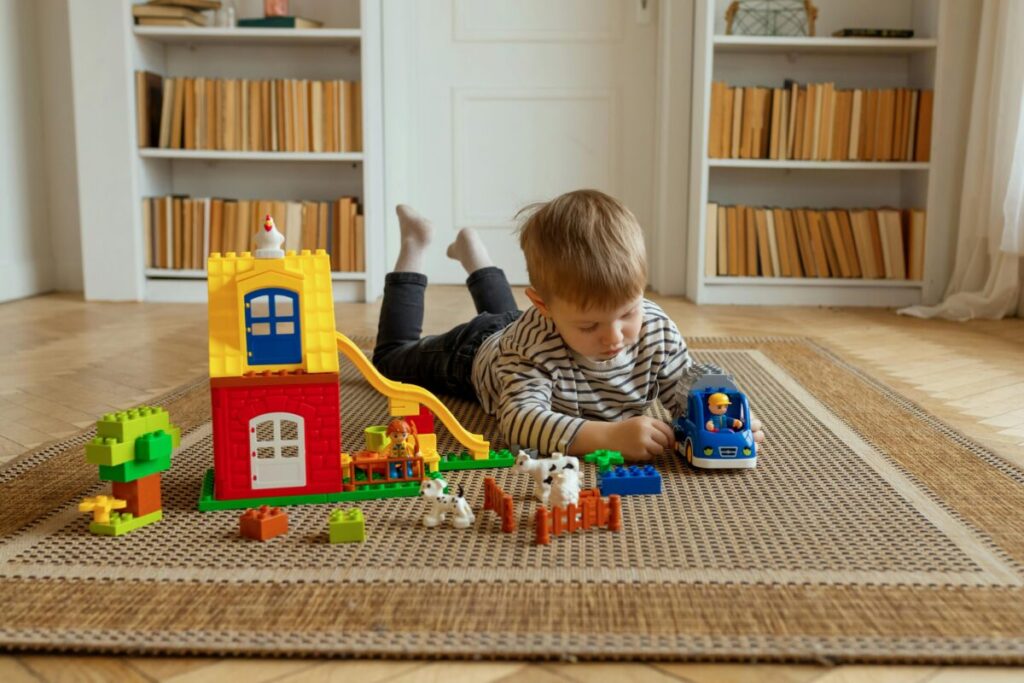
Physically, this stage is honestly exhausting because they suddenly want to move all the time. Running, climbing, jumping off things they absolutely should not be jumping off of… it’s constant. One second they’re sitting quietly with a snack, and the next they’re somehow standing on the couch trying to reach something dangerous you didn’t even notice before.
And they get into everything now. Cabinets, drawers, random baskets, your purse, the dog’s water bowl. Nothing is safe anymore.
At the same time though, it’s kind of amazing watching how much they can suddenly do on their own. They try using spoons, stacking blocks, carrying things across the room with extreme confidence for no reason. Even if half the yogurt ends up in their hair or on the floor, they’re determined to do it themselves — which is exactly why figuring out how to encourage 20 month old independent play becomes so important right now.
I also had this huge guilt phase around independent play. I honestly thought being a “good mom” meant constantly entertaining my toddler every second of the day. If I sat down for too long or tried to answer a text while he played, I’d immediately feel guilty about it.
But one day I was so tired I physically couldn’t keep doing floor play anymore. I sat on the couch for a minute, and my toddler wandered over to a random kitchen bowl and a pile of blocks and entertained himself for way longer than I expected.
And weirdly, that moment helped me realize they don’t actually need us directing every second of their play. Sometimes they just want space to explore weird little toddler ideas on their own.
Learning how to encourage 20 month old independent play was a total life-saver and a breakthrough for both of us. It turns out that when we constantly intervene, narrate, and direct our children’s play, we actually steal their opportunity to develop deep focus, frustration tolerance, and true problem-solving skills. Boredom is often the exact spark a toddler needs to activate their imagination.
If you want to know how to encourage 20 month old independent play without that crushing weight of mom-guilt, you have to start small. Create a safe, enclosed space where you don’t have to constantly jump up and say “no” or “don’t touch that.” Set out a few open-ended items. Ironically, you don’t need expensive, flashy toys that blink, sing, and cost a fortune. In fact, those electronic toys often overstimulate them and lead to much shorter attention spans.
Instead, look to your kitchen cabinets. A stack of safe plastic Tupperware containers, a wooden spoon, and a few large clean socks can keep a twenty-month-old captivated far longer than a high-tech toy. Sit nearby with your coffee, look accessible so they feel safe, but let them lead the exploration. If they look at you for help with a toy, instead of jumping in and doing it for them, try leaning back and saying, “Hmm, I wonder how that fits together? You try.” You will be amazed at the confidence that blooms when they figure it out on their own.
20 Month Milestones: A Quick Checklist of What’s Happening
While every single child develops on their own beautiful, completely unique timeline, there are a few common behavioral themes that tend to surface during this specific month. When looking at 20 month milestones, it helps to view them as a wide, flexible spectrum rather than a terrifying, strict deadline. Here is a realistic, zero-judgment look at what your little one might be experimenting with right now:
- Language Growth: They are likely adding new words to their vocabulary every single week. They might be imitating random sounds they hear around the house or attempting simple, muddy two-word phrases like “More milk” or “Bye-bye doggie.” Even if the words aren’t perfectly clear to anyone else, the desperate intent to communicate is highly evident.
- Social Imitation: Your shadow has never been closer or more intense. They love to copy everything you do. If you sweep the floor, they want a broom. If you wipe down a counter, they want a cloth to wipe the floor with. This is how they learn to become part of the family community.
- Spatial Awareness: They are beginning to understand concepts like “up,” “down,” “inside,” and “outside.” You might see them spending an immense amount of time putting small objects inside containers, dumping them back out on the floor, and repeating it fifty times.
- Empathy and Connection: You might notice early, sweet signs of empathy. If they see you looking sad or if another child cries at the playground, they might stop, look concerned, or offer a sticky, half-chewed favorite toy or blanket to help soothe the situation.
If your little one hasn’t mastered all of these areas yet, please don’t panic or spend hours spiraling down a terrifying late-night internet search rabbit hole. Brain development isn’t a straight line. Often, a toddler will focus intensely on mastering a physical skill like climbing or running while their language skills temporarily take a backseat for a few weeks, or vice versa. Trust your gut, mention anything that truly concerns you to your pediatrician, and remember to look at the whole, wonderful picture of who your child is becoming.
The Nighttime Reality Check: Molars and Midnight Wake-Ups


Just when you think you have finally figured out a solid nap schedule and a predictable nighttime routine, the universe likes to laugh and throw a wrench into the whole machinery. If your peaceful sleeper has suddenly started screaming the moment their mattress touches their back, or waking up crying hysterically at 2:00 AM, you are likely dealing with the brutal physical discomforts of this stage.
A massive, exhausting hurdle during this phase is the 20 month old molars sleep disturbance. Those second molars are large, flat, heavy teeth, and breaking through thick gums can be incredibly painful. Unlike the front teeth that pop through relatively quickly, molars can take what feels like an absolute eternity to fully emerge, causing a dull, low-grade discomfort that intensifies the moment they lie down to rest because the blood pressure shifts to their head.
A few weeks ago, we had one of those nights that feels endless when you’re in it. My toddler woke up around 3 AM screaming, and nothing was working. I tried rocking him, walking around the room, offering water, checking his diaper… everything. The second I tried putting him back down, he’d start crying all over again.
His molars were coming in, he was overtired, clingy, uncomfortable — honestly it just felt like too much all at once for his little body.
And after a while, I could feel myself getting overwhelmed too. Like the kind of tired where you suddenly feel angry, emotional, guilty, exhausted… all at the same time.
So my husband took over for a few minutes, and I walked into the kitchen and ate chocolate in the dark like a tiny burnt-out raccoon hiding from responsibility.
And weirdly? That little reset actually helped.
It didn’t magically fix the teething or make the night easier, but it gave me enough patience to go back in there calmer instead of completely overstimulated and frustrated.
When you are navigating a 20 month old molars sleep disturbance, give yourself and your child an immense amount of grace. All your strict sleep hygiene rules might temporarily go out the window, and that is completely okay. Use cool teething rings, talk to your pediatrician about safe pain relief options for those particularly brutal nights, and offer extra cuddles. This is a temporary physical phase, not a permanent regression or a reflection of your parenting. The teeth will eventually come through, and the peaceful nights will return.
P.S. If you’re currently dealing with a sick toddler who is refusing to eat, you might find my guide on What to Feed a Toddler With a Cold: Comfort Foods That Boost Immunity really helpful for those tough days.
Read Next on Tiny Care Tips:
- 🦕 Wondering what the heck is going on with your almost-two-year-old right now? Get the real tea in: 21 Month Milestones: A Brutally Honest Survival Guide for Tired Moms
- 📺 Wondering if that video is melting their brain while you clean the kitchen? Read the truth in Screen Time Guilt: Why 20 Minutes of ‘Ms. Rachel’ Doesn’t Make You a Bad Mom.
- 👹 Thinking ahead to the next sleep crisis? Here is what’s coming: Bedtime Battles: Why Your 2-Year-Old Is Suddenly Afraid of the Dark (and 14 Other Excuses).
- 🤒 Tired of the endless runny noses and nursery germs? Check out The Daycare Crud: How to Build Your Toddler’s Immunity (Without Living in a Bubble).
You Are the Anchor in Their Storm
Take a moment to look back at how far you have come since those blurry, terrifying newborn days. You have survived the sleepless infant stages, the crazy transition to solid foods, and now you are guiding a beautiful, fiercely independent little human through the wild waters of toddlerhood.
The days can feel incredibly long right now. The tantrums are loud, the boundary testing can feel constant, and the physical exhaustion is real. But the nights are short, and this intensely messy, passionate, beautiful phase will eventually shift into something new.
Both of those moments are completely normal, beautiful, and necessary parts of navigating the wild ride of 20 month milestones. You don’t have to be a perfect, textbook parent to be an incredible mom. You just have to be there, holding the boundary and offering the hug when their little world feels too big to handle.
I see you, mama. You are doing a wonderful job, your toddler loves you fiercely, and we are going to get through this together, one cup of reheated coffee at a time. We’ve got this.