My kid once bit a toy out of another kid’s hand. Not out of malice. Out of pure, unfiltered, “this is mine now” instinct. The other mom just stood there blinking at me like I’d let a raccoon loose at the park. I wanted to sink into the mulch and disappear.
If you’ve ever stood frozen at a playground while your toddler snatched a bucket, a scooter, or literally anything not nailed down, and felt every parent within a 20-foot radius silently judging you — welcome. You’re not raising a monster. You’re raising a two-year-old. There’s a difference, even if it doesn’t feel like it in the moment.
Toddler sharing struggles are so universal that I genuinely think someone should print “MINE” on a onesie and sell it as a rite of passage. Let’s talk about why this happens, and what actually helps — not the Pinterest-perfect version, the real one.
Wait, are they actually selfish? Understanding toddler sharing struggles

Short answer: no. Long answer: also no, but let me explain it like the technician I am, because logic is the only thing that gets me through the day.
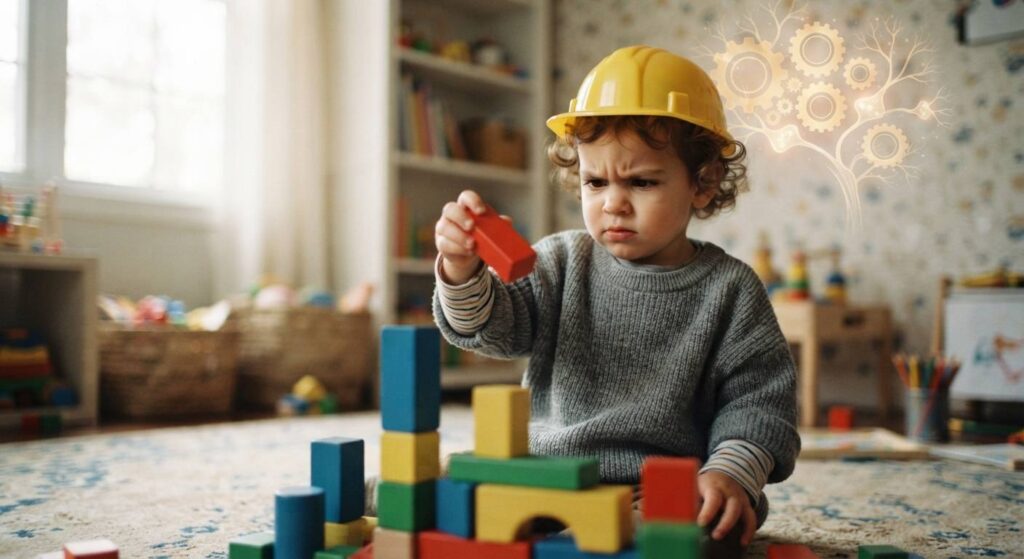
Here’s the thing about toddler brains — they’re not broken versions of adult brains. They’re brains still wiring the most basic circuit of all: “I exist, and I am separate from you.” That’s it. That’s the whole project right now.
Until that circuit is built, everything in their hands feels like an extension of their own body. Taking a toy away can feel, to them, less like “sharing” and more like someone trying to take their arm. Dramatic? Sure. But also kind of true, neurologically speaking.
This is what child development folks call being egocentric — not selfish, egocentric. It’s one of the classic toddler social development milestones, right up there with parallel play and throwing spaghetti as a personal art form. They’re not ignoring other people’s feelings on purpose. They genuinely can’t fully access them yet. That part of the brain is still under construction, and construction is loud, messy, and takes way longer than the blueprints promised.
This is one of the classic social development milestones for toddlers. They aren’t ignoring other people’s feelings on purpose; that part of the brain is still under construction. Communication is a fundamental part of this development—the better children can express their needs, the easier it becomes for them to navigate social challenges. For more tips on supporting your little one’s language skills, check out our article: [The 2-Year-Old Speech Explosion: When to Worry and How to Encourage More Talking].
I like to think of it like installing new software on an old machine. The processor (their brain) is running as fast as it can, but the “empathy and sharing” update hasn’t fully downloaded. You can’t rage-click your way through a loading bar. Trust me, I’ve tried, both with laptops and toddlers.
The playground disaster that humbled me


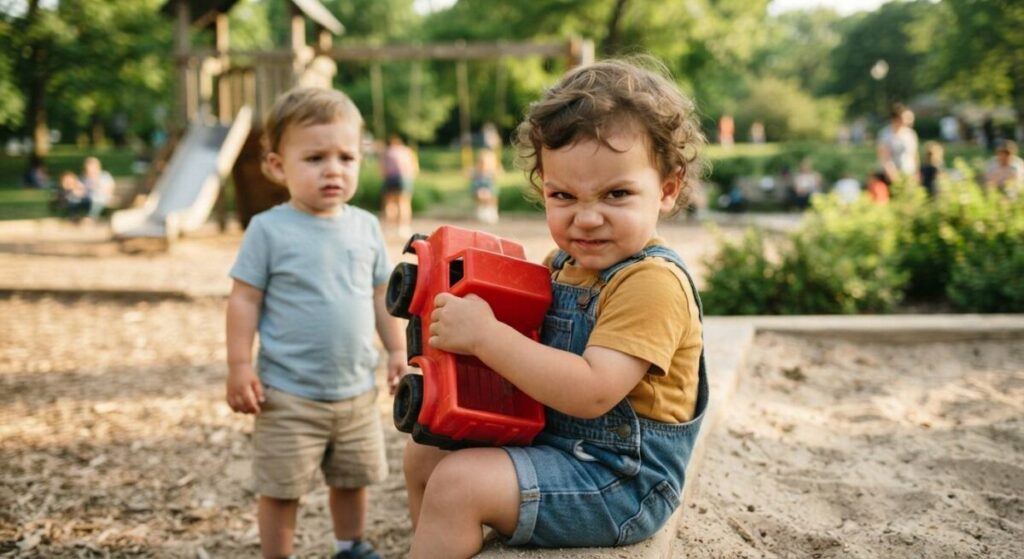
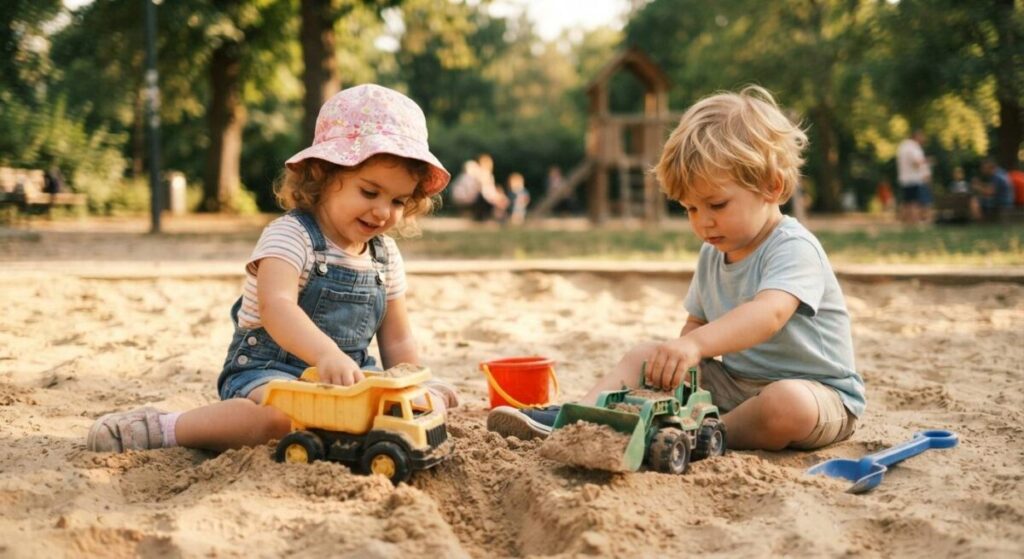
Okay, story time. We were at the park, my son was maybe two and a half, and there was this little truck. Not his truck. A stranger’s truck, half-buried in sand, momentarily abandoned by its rightful three-year-old owner who’d wandered off toward the swings.
My son saw it, walked over like he owned the place, and just… took it. Full toddler swagger. The other kid noticed approximately four seconds later and the wailing began immediately.
I did what any reasonable adult does: I panicked and tried to logic my way out of it. “Buddy, that’s not your truck. We have to give it back. Sharing is caring, remember?” I said this in my calmest, most Montessori-teacher voice while internally screaming.
He looked at me like I’d suggested he give away his own kidney. Full meltdown. Truck flew. Sand flew. I ended up crouched in the sandbox holding a shrieking toddler while the other kid’s mom gave me the world’s tightest, most polite smile — the universal playground signal for “I am judging you but I will not say it out loud.” It was just another classic chapter in the ongoing book of toddler sharing struggles that every parent eventually has to write.
Here’s what I learned, eventually, after the adrenaline wore off: I was trying to debug the situation like it was a hardware issue. Explain the rule, expect compliance, move on. But emotions aren’t circuits. You can’t just flip a switch labeled “empathy” and expect the light to turn on. What actually helped, in the moment, wasn’t logic — it was naming what he was feeling before asking him to do anything about it.
The playdate that taught me you can’t force it
Round two of my humbling era: we had a friend’s kid over for a playdate, and I decided — genius move — that this would be the perfect opportunity to “practice sharing.” I even prepped my son beforehand. “When Mia comes over, we’re going to share our toys, okay?” He nodded. I felt like I’d won. In hindsight, I was ignoring some pretty basic toddler social development milestones — specifically, the fact that at this age, their capacity for empathy is still just a tiny seedling, not a full-grown tree.
Mia arrived. Mia touched the dinosaur. My son’s entire nervous system short-circuited.
I tried to mediate like I was debugging a system error. “Okay, you had it for two minutes, now it’s her turn, that’s fair, that’s how sharing works.” I said “fair” like fairness was a concept a two-year-old had any interest in whatsoever. Spoiler: he did not.
He grabbed the dinosaur back, Mia cried, my son cried, I sat on the living room floor wondering if I was somehow the only parent on earth who couldn’t get this to work. I had approached the whole afternoon like a technical problem with a technical solution — explain the rule, enforce the rule, expect the outcome. But toddlers don’t run on logic. They run on feelings that are enormous and immediate and have absolutely no patience for my very reasonable explanations. I realized right then that how to teach toddlers to share isn’t about finding the perfect explanation, but about finding a rhythm that respects their current developmental limits.
What actually calmed things down wasn’t more explaining. It was taking the dinosaur out of the equation entirely for a minute, letting both kids have their feelings, and then reintroducing the toy with a very simple, very concrete system instead of an abstract concept like “sharing.”
Which brings me to the actual point of this whole article.
What actually helps (the stuff that isn’t just “try harder”)
I’ve read a lot of gentle parenting tips for possessiveness that sound lovely in theory and fall apart in real life. Here’s what’s genuinely worked for us, minus the fluff:
- Ditch “sharing,” teach “taking turns.” Sharing is abstract and scary — it sounds permanent, like the toy might just vanish forever into someone else’s hands. Turns are concrete. “You have it now, then it’s her turn, then it’s your turn again” gives their brain an actual structure to hold onto.
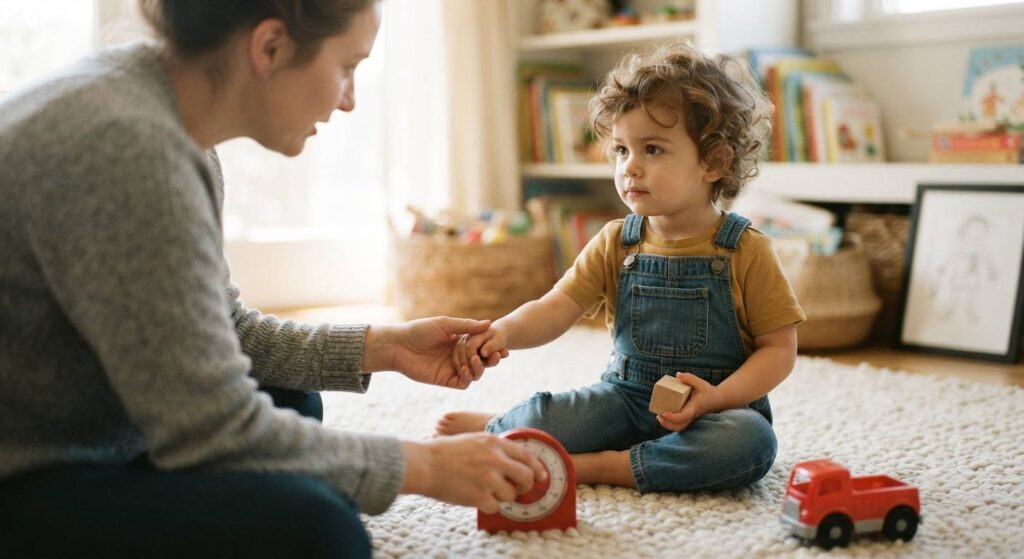
- Use a timer, not your patience. Your toddler doesn’t trust you to fairly judge “long enough.” They will trust a timer that dings, because the timer has no agenda and doesn’t seem to be taking anyone’s side. Two minutes each, timer dings, toy switches. Boring, mechanical, and it works shockingly well.
- Narrate their feelings before you ask for the behavior. “You’re mad because you wanted to keep playing with it” lands so much better than jumping straight to “you need to share.” Feel first, act second — that’s true for all of us, honestly, not just two-year-olds.
- Have duplicates for high-value items when you can. Two of the same shovel at the sandbox erases 80% of the drama instantly. It’s not a permanent life skill, it’s just crowd control, and there’s no shame in that.
- Let them practice with low-stakes objects first. Sharing crackers is a lot easier than sharing the one toy they’ve bonded with like it’s a family member. Build the muscle on easy reps before asking for the heavy lifting.
- Praise the attempt, not just the success. If they hesitate before grabbing, or offer a toy for half a second before changing their mind, notice that out loud. That flicker of hesitation is the actual skill developing, even if it doesn’t look like a finished product yet.
None of this is magic. Some days the timer gets thrown across the room. Some days “turns” turns into a full-body protest. That’s not a sign you’re failing — it’s a sign you’re raising a human whose brain is still under construction, same as it was yesterday and will be tomorrow. And honestly, while you’re figuring out how to teach toddlers to share, remember that these messy, imperfect moments are exactly where the real progress happens.
Building these skills takes time, but remember that play is the best practice ground. Instead of focusing solely on the ‘sharing’ struggles, try introducing activities that keep them engaged, happy, and less prone to territorial meltdowns in the first place. If you’re looking for some inspiration that won’t turn your house upside down, check out our guide on Low-Mess Holiday Magic: Toddler-Friendly Activities for Halloween & Christmas — it’s full of ways to keep those busy little hands occupied during the holidays.
We’re all just doing the best we can here
If you’ve had your own playground moment, your own playdate meltdown, your own quiet drive home wondering if you’re somehow getting this wrong — you’re not. Toddler sharing struggles aren’t a parenting failure. They’re a developmental stage, and a genuinely hard one, for them and for us.
Your kid isn’t selfish. They’re building the most complicated piece of software there is — a sense of self — and it’s going to take a while to load. In the meantime, we narrate feelings, we set timers, we sit in sandboxes we didn’t plan to sit in, and we survive the tight-lipped smiles from other parents. That’s the job. You’re doing it fine.
Before you go
If you’re deep in toddler-parenting-trenches mode, you might also want:
- What to Feed a Toddler With a Cold — for the days when snacks feel like the only battle you can actually win.
- The 2-Year-Old Speech Explosion — because right around the time they learn to say “mine” with total confidence, they’re also learning about forty other words a week, and it’s wild.