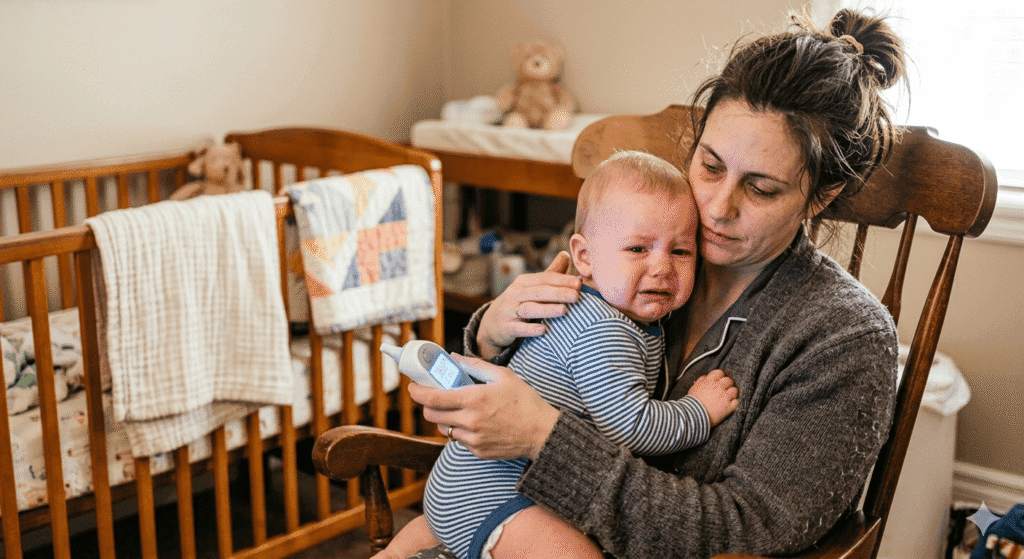
There’s a moment I keep thinking about lately.
I’m standing in the pantry with the door cracked shut, leaning against a shelf full of canned soup and cereal boxes, holding an ice-cold Coke against my forehead while my toddler completely loses it in the kitchen. She’s screaming because she wants goldfish crackers—the exact ones sitting three feet away—but apparently, I handed them over in the ‘wrong’ bowl, so civilization is collapsing. In moments like this, I realize this is exactly what mom burnout feels like: the breaking point reached over a goldfish cracker.
And I remember just standing there for a minute longer than I probably should have. Not hiding exactly. Just trying to breathe before walking back into the noise.
The screaming kept going, but after a while it almost blurred into the background — like my brain temporarily stopped processing it because it physically couldn’t anymore.
That was one of the first times I realized how sneaky mom burnout actually is.
It’s usually not some dramatic movie moment where you completely fall apart. Most of the time it looks weirdly ordinary. Like reheating the same coffee four times. Like sitting in your parked car for an extra minute before going inside. Like hiding in a pantry holding a soda can to your face because it’s the first cold, quiet thing you’ve experienced all day.
And honestly? I think a lot more moms are barely holding it together than anyone admits out loud.
When You’re Running on Fumes and Everybody Still Needs Something


You know you’ve hit the wall when even the sound of your own name makes you flinch.
It’s not just tired. Everyone’s tired. This is something else — a full-body depletion where your skin feels too sensitive, sounds feel too sharp, and the phrase “Mommy, can I—” makes something inside you want to scream. You’re not responding to your kids anymore, you’re reacting. There’s a difference. Reacting means the noise hits your nervous system before your brain even has time to process it. You snap. You tense. Your jaw goes tight and your shoulders live somewhere near your ears and you don’t even notice anymore because that’s just your default setting now.
That’s overstimulation. And for moms — especially moms of small kids, especially moms who work, especially moms who never get a moment alone — it’s not an occasional bad day. It’s the water you’re swimming in.
Knowing how to handle overstimulation as a mom starts with recognizing what it actually feels like in your body. It’s not always rage or tears. Sometimes it’s that weird, dissociated numbness. Like you’re watching yourself go through the motions of making dinner, filling sippy cups, answering “why” for the forty-seventh time — but you’re not quite there. You’re running, but on empty.
Why Your Nervous System Is Doing This (And Why It Doesn’t Make You a Bad Mom)
Here’s the thing nobody explains when you have a baby: your nervous system doesn’t care how much you love your children. It’s not a feelings machine. It’s a threat-detection system, and it’s been running at high alert since the moment you became responsible for keeping another human alive.
The constant noise, the physical contact, the emotional demands, the mental load of tracking everyone’s schedules and snack preferences and doctor’s appointments — all of that is input. Relentless, never-ending input. And your nervous system, which was designed to handle a certain amount before needing to reset, has been asked to handle way more than that for way longer than it was built for.
Mom burnout isn’t a character flaw. It’s a physiological response to chronic overwhelm. Your cortisol levels are elevated. Your sensory processing is maxed out. You’ve been “on” for so long that you’ve forgotten what “off” even feels like.
The banana incident comes to mind. One morning my daughter dissolved into a full emotional crisis — and I mean dissolved, like we’re talking tears streaming, body on the floor — because I peeled her banana. Not wrong. Not badly. I peeled it. That was the crime. Apparently she wanted to peel it herself, and now the banana was ruined, and by extension her entire morning. And I remember standing there, looking at this limp piece of fruit, feeling a very specific kind of exhaustion that went somewhere below bone. Not frustration. Just… the complete inability to absorb one more thing.
That moment — the banana moment, the crayon-broke-wrong moment, the shoe-is-touching-my-foot moment — that’s where mom burnout lives. In the accumulation of thousands of tiny, unreasonable things that individually mean nothing and collectively mean everything.
The Sensory Hacks That Actually Help (And Don’t Require a Spa Day)


I used to think self-care had to look impressive to “count.”
Like if I wasn’t drinking coffee alone in a peaceful café somewhere or escaping on a weekend trip, then it didn’t really qualify as taking care of myself. But honestly, when you’re deep in parenting exhaustion, self-care usually looks way less glamorous than that.
Most of the time it’s tiny survival habits that help you get through the next hour without completely snapping.
One thing that weirdly helps me almost every time is cold water. Sometimes I’ll go into the bathroom, splash freezing cold water on my face, and just stand there for a second breathing while the toddler chaos continues outside the door. It sounds ridiculously simple, but it helps interrupt that overwhelmed, buzzing feeling in my head.
Another thing? Lowering the noise whenever possible.
I didn’t realize how overstimulated I was until one afternoon when the TV was on, my toddler was loudly narrating every thought in her brain, the baby monitor was crackling, the dog was barking at absolutely nothing, and I suddenly felt irrationally angry about someone chewing too loudly near me.
Now sometimes I put in one earbud or wear soft earplugs while I’m cleaning or cooking. Not to ignore my kids — I can still hear them perfectly fine — but just to take the sharp edge off the constant noise for a little while.
And honestly, I still use the pantry trick sometimes.
A cold drink. Dim light. Door mostly closed. Two quiet minutes leaning against a shelf pretending I’m “looking for something.”
That’s self-care some days.
I’ve also noticed that when I’m overwhelmed, I stop noticing my own body completely. My shoulders tense up. I hold my breath without realizing it. My jaw hurts because I’ve been clenching it for hours.
So now when I feel myself getting close to overstimulation, I try to pause for literally ten seconds and reset physically first. Feet on the floor. Shoulders down. One slow breath all the way out.
Not because it magically fixes motherhood.
Not because suddenly everyone stops needing things from me.
But because tiny resets sometimes keep a hard moment from turning into a full emotional explosion.
And honestly, I think exhausted parents need to hear this more often: you do not need to “earn” small moments of care. You don’t need a babysitter, a perfect schedule, or a full spa day to deserve five quiet minutes or one deep breath.
Sometimes taking care of yourself just means noticing that you’re overwhelmed before you completely hit the wall.
The Mom Guilt That Shows Up the Second You Take a Break
Here’s the part that makes practical self-care for exhausted parents so much harder than it should be: you finally do the thing — you hide in the pantry, you take a long shower, you ask your partner to handle bedtime — and instead of feeling relief, you feel guilty.
Mom guilt and burnout recovery are tangled together in a way that’s genuinely maddening. You can’t recover without rest. But you feel guilty resting. So you don’t rest. So you burn out harder. So you need more rest. Which you feel more guilty about. Round and round.
I stood in that pantry with my Coke and I felt it — the guilt threading in before I’d even finished the first sip. She needs you. You’re hiding. What kind of mother hides from her toddler. Never mind that I’d been awake since 5:47 a.m. Never mind that I’d already made breakfast, found the specific pink cup, supervised a craft project, broken up two sibling disputes, and answered approximately nine hundred questions before 10 a.m. The guilt doesn’t do math.
But here’s what I’ve had to remind myself, and what I want to say to you directly: a nervous system that’s completely fried isn’t just bad for you. It’s bad for them. When you’re running at zero, you have nothing to give. Not patience, not warmth, not real attention. The five minutes in the pantry isn’t you failing your kid. It’s you keeping yourself functional enough to be the parent they actually need.
Mom guilt and burnout recovery cannot coexist if you treat guilt as the authority. It’s not. Guilt is a feeling, not a verdict. You can feel it and still do the thing anyway.
Recommended Reading for Your Burnout Recovery
You aren’t just a parent; you’re a person, and I know how much weight you’re carrying right now. If you’re looking for more ways to lighten the load and navigate the daily chaos, these guides were written for moments just like this:
- [The Mental Load: Why You’re Exhausted Even When Your Baby Sleeps] – If you feel like your brain is a browser with a hundred tabs open, this will help you understand why you’re so tired.
- [The Toddler Dinner Battle: How to End the “No Veggies” War Without Losing Your Mind] – Because dinner shouldn’t be the most stressful hour of your day.
- [Why Your Toddler Acts Like a Monster: 5 Phrases That Stop a Tantrum in Under a Minute] – Keep these in your back pocket for the next time you feel that overstimulation starting to rise.
You’re Not Failing — You’re Depleted. There’s a Difference.
Mom burnout is not the same as not caring. It’s not the same as being a bad mother. It’s what happens when someone who cares enormously — who has been pouring and pouring and pouring — finally hits the bottom of the vessel.
The moms who burn out are, almost always, the ones who are trying the hardest. They’re the ones who said yes when they should have said no. Who pushed through when they should have stopped. Who held everyone else together and forgot, for a really long time, to hold themselves.
If you’re reading this while hiding in a bathroom or sneaking a cold cup of coffee in the kitchen while the kids watch one more episode than you planned — I see you. Knowing how to handle overstimulation as a mom is a survival skill, and the fact that you’re looking for ways to cope instead of just going under means you’re still fighting for yourself. That matters.
Take the break. Drink the Coke in the dark. Put the earplugs in. Splash cold water on your face and stand there for a minute. Let yourself have the five minutes even while the guilt is talking, even when it’s loud. Because your kids don’t need a perfect mother. They need a mother who comes back to herself.
And you will. You always do.
You’re doing better than you think. On the days when the best you could give was just showing up — that was enough. It always was.