Let’s talk about that heavy, nagging toddler screen time guilt we all carry. Honestly? That Tuesday morning was chaos. “I-haven’t-brushed-my-teeth-yet” kind of confession.
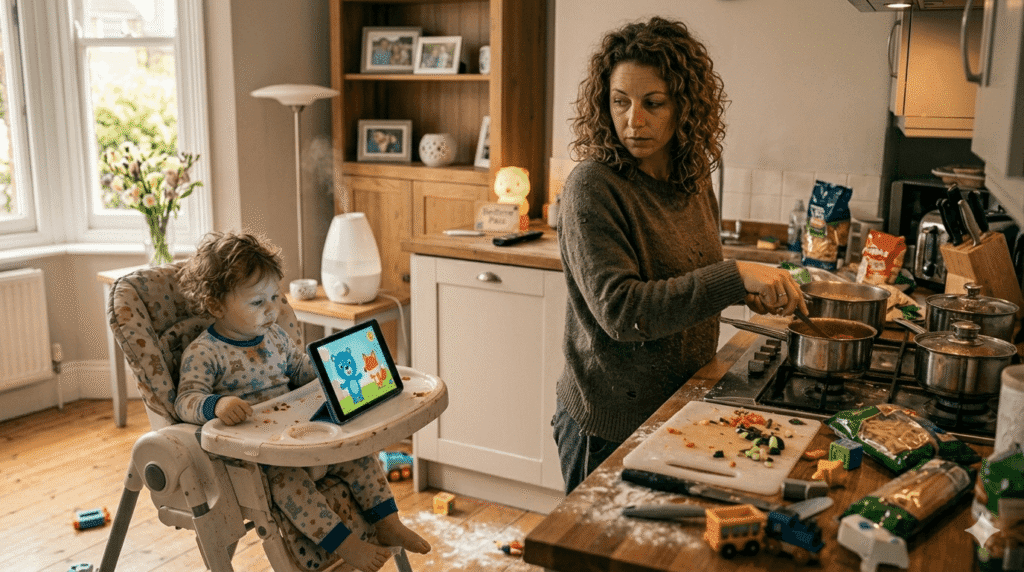
It was 7:30 AM on a Tuesday. The coffee I’d brewed twenty minutes ago was sitting on the counter, stone-cold. My toddler was currently wrapped around my left leg like a very loud, very persistent barnacle, screaming because I wouldn’t let them eat a frozen waffle while it was still frozen. I felt that familiar, hot prickle of a “mom-meltdown” bubbling up in my chest.
So, I did it. I reached for the iPad, tapped on that familiar red YouTube icon, and handed it over.
Silence.
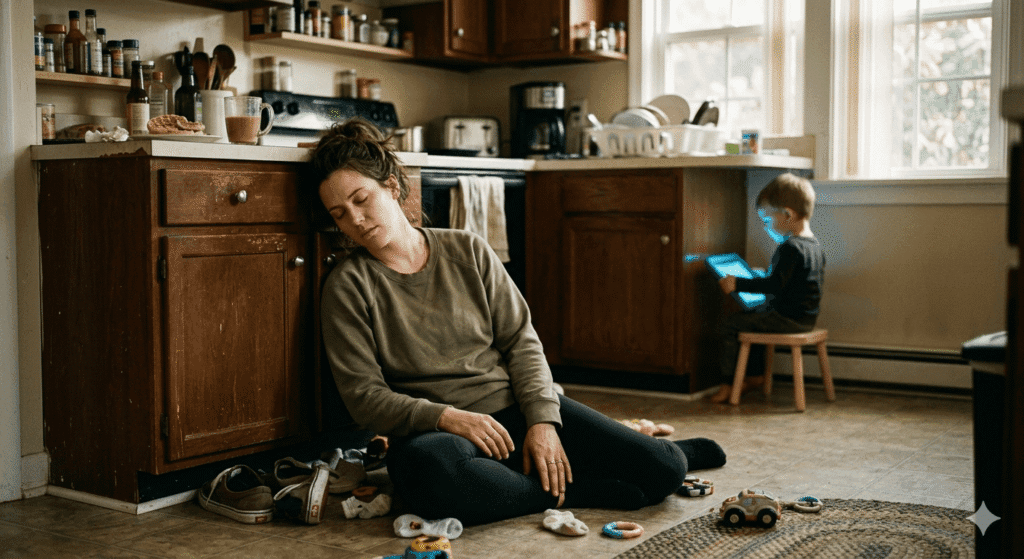
Pure, unadulterated, glorious silence. I sat on the kitchen floor, leaned my head against the cabinet, and just breathed for ten minutes. But, wait—almost immediately, the “Mom Guilt” started creeping in. Am I rotting their brain? Should we be doing sensory play with organic chickpeas right now? Am I a “bad mom” for needing a digital babysitter just to survive the morning?
If you’ve been there and felt that pit in your stomach. We’re basically raising toddlers with supercomputers in our pockets, and honestly? The pressure to be “screen-free” is exhausting.
But wait. Before we throw our devices into the nearest lake, let’s take a breath and talk about how to find balance without losing our minds.
Understanding the Toddler Screen Time Guilt Trap
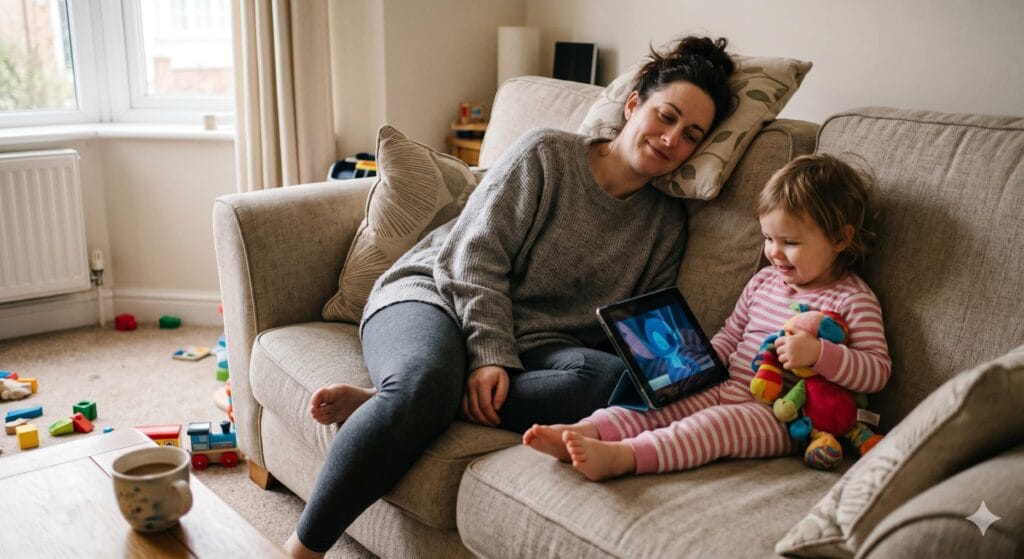
But honestly: Using a screen does not make you a failure. We live in a culture that romanticizes the “Pinterest Mom” who spends eight hours a day and somehow has time for perfect crafts and calm mornings. But let’s be real—that’s not real life for 99% of us. Most of us are juggling jobs, laundry, meal prep, and the sheer emotional toll of raising a tiny human who has the mood swings of a rock star.
We feel guilty because we’ve been told that screens are “toxic.” But wait, is it the screen itself, or is it the shame we attach to it? Zero screens is a beautiful goal, but for many of us, it’s just not a sustainable reality. When we buy into the “zero screens or you’re a bad parent” narrative, we just end up stressed, touched-out, and miserable. And guess what? A stressed-out, miserable mom is way worse for a toddler than twenty minutes of Bluey.
We often feel like we’re failing when we use screens to get a break, but this emotional rollercoaster is common during any major parenting transition. Whether you are navigating screen limits or following a gentle weaning guide to stop nursing, the secret is the same: lead with compassion for yourself, not just for your child.
Why Screens are Magnetic: The “Zombified” Toddler

Have you ever noticed that “look” they get? The slack jaw, the unblinking eyes, the total disconnection from the physical world? We call it being “zombified,” and honestly, it’s a little creepy.
But it’s not that simple: It’s not magic. It’s just dopamine. And yeah — it kind of makes sense when you see it. Kids just can’t filter it like we do, and most modern kids’ content is designed to be high-speed, high-color, and high-noise. It’s a sensory overload. Their tiny brains are basically working overtime just to keep up with the flashing lights and loud music. It’s a total dopamine overload—like their brain is completely overstimulated and they don’t want the party to ever end.
Transitions are notoriously hard for little ones because they crave control. If you’ve been wondering Why Your Toddler Says “No” to Everything the moment you reach for the iPad, it’s usually not about the show—it’s about their need for autonomy. Giving a warning helps them feel like they are part of the decision, not just a victim of it.
Understanding the science of dopamine can actually help ease the toddler screen time guilt because you realize it’s a physiological reaction, not just bad behavior. Once you see it as biology, it’s much easier to quiet the toddler screen time guilt that tells you it’s your fault.
Wait, this explains the screaming. When you turn the TV off, that dopamine hit disappears instantly. It’s a literal crash. They aren’t just being “naughty” when they have a meltdown after the iPad goes away; their brain is struggling to adjust back to the “slow” real world where things don’t change colors every two seconds. It’s like taking a shot of espresso and then being told to take a nap—it just doesn’t work that way.
Wait, Not All Screens are Evil (Low-Stimulation vs. High-Stimulation)
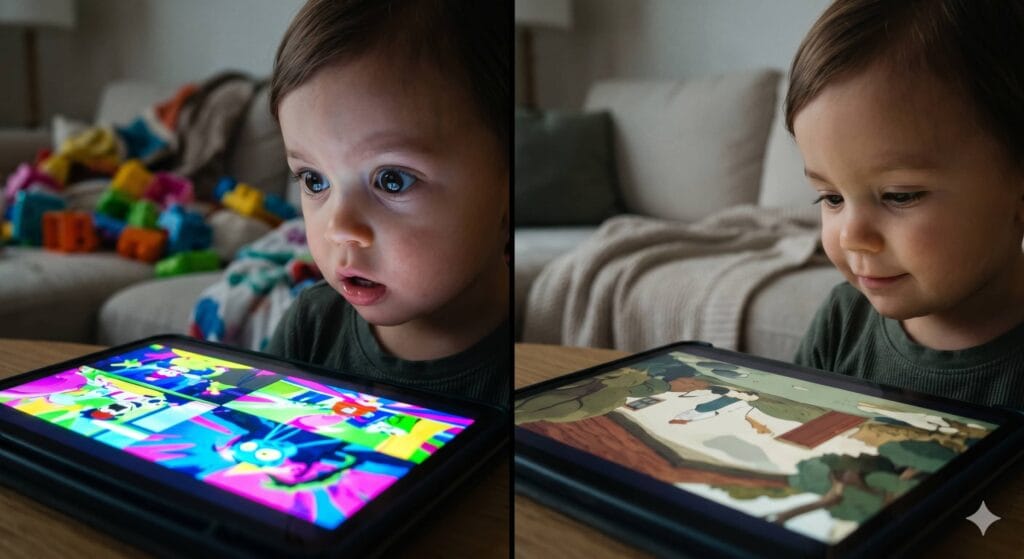
If you want to reduce your toddler screen time guilt, the first step is understanding that not all content is created equal.
This was a huge “aha!” moment for me. Not all screen time is created equal. Think of it like food. There is “junk food” content and “nourishing” content.
- High-Stimulation (The Junk Food): These are the shows with bright neon colors, frantic music, and scene changes every 1-3 seconds. Think Cocomelon or those weird “unboxing” videos. They “fry” the toddler’s attention span and lead to much worse tantrums when the screen turns off.
- Low-Stimulation (The Whole Foods): These shows have muted colors, natural pacing, and stories that follow a logical flow. Think Trash Truck, Puffin Rock, or Little Bear.
Look, if you need to use a screen, choose the “slow” shows. Your toddler will be less likely to turn into a screaming puddle of tears when it’s over because their nervous system wasn’t pushed into overdrive. But wait, don’t feel bad if they occasionally see a ‘fast’ one—we’re talking about the 80/20 rule here.
The “Survival Mode” Reality: Screens as a Tool for Mental Health
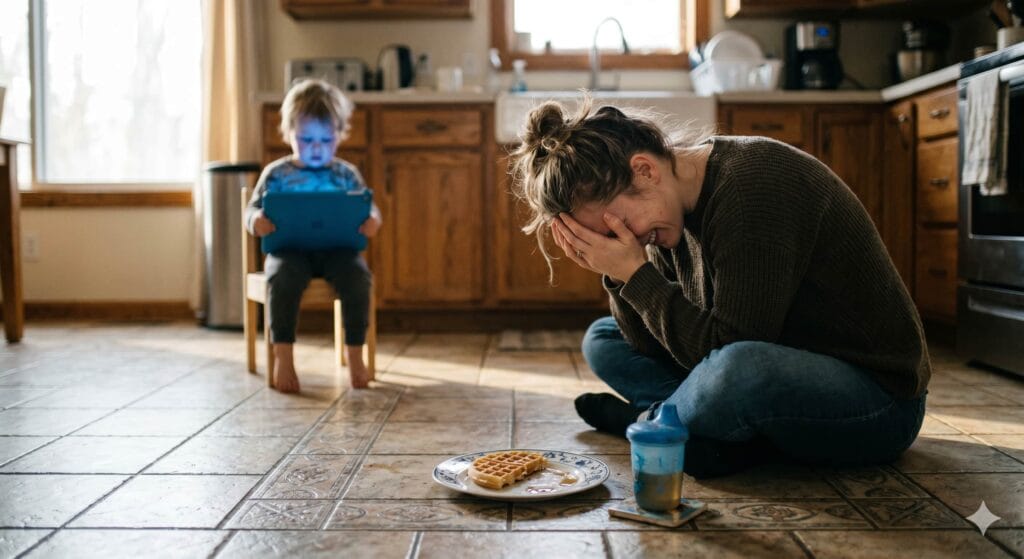
At the end of the day, it’s essential to remember that screens can also serve as a valuable tool for mental health—not just for your toddler, but for you as well. When you’re feeling overwhelmed, allowing your child a bit of screen time can provide you with that much-needed moment to recharge. By implementing practical strategies like the 5-minute warning, you can ease transitions and reduce the chaos. Embracing a balanced approach to toddler screen time guilt means recognizing that it’s okay to lean on digital resources when needed, creating a healthier, calmer environment for both you and your child.
Let’s be honest: in survival mode, your toddler screen time guilt shouldn’t even be invited to the conversation.
If you are sick, if you have a deadline, if you are solo-parenting for a week, or if you just… cannot… then the screen is a tool. It is a tool for your mental health. I’ve had days where the only way I could cook a hot meal without someone pulling a pot of boiling water onto their head was by putting on a movie. Look, let’s call it what it is. In those moments, the iPad isn’t a babysitter—it’s a freaking survival tool. If it keeps them from sticking a fork in an outlet while I’m trying to boil pasta, I’m taking that win.
We need to stop seeing screen time as a “loss” and start seeing it as a “strategic pause.” If twenty minutes of a show allows you to show up as a calmer, kinder, more patient mother for the rest of the day, then that screen served a purpose. — If it keeps them from sticking a fork in an outlet while I’m trying to boil pasta, I’m taking that win and leaving the toddler screen time guilt at the kitchen door
If you are sick, if you have a deadline, if you are solo-parenting for a week, or if you just… cannot… then the screen is a tool. It is a tool for your mental health. For a deeper dive into making this work without the stress, you can read my full The Screen Time Struggle: A Guilt-Free Guide for Toddler Moms, where I break down more specific ways to manage the daily juggle.
Practical Strategy: The 5-Minute Warning (And Other Sanity Savers)
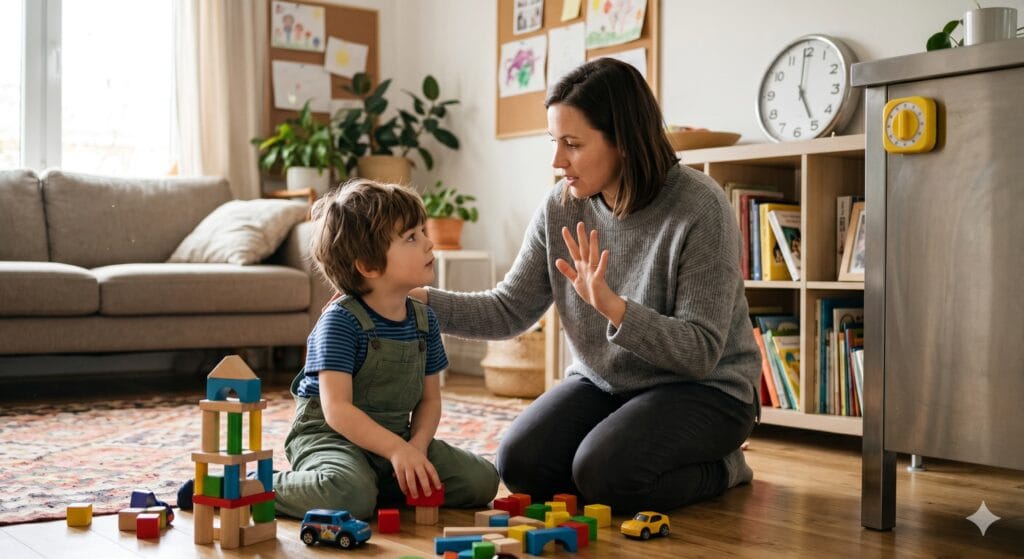
The hardest part of screen time isn’t the watching—it’s the stopping. If you just walk over and “click” the TV off, you are essentially declaring war on a toddler.
Here is how to end the session without a 30-minute tantrum:
- The Multi-Step Warning: Give a 5-minute warning, a 2-minute warning, and a “one last song” warning. Look, toddlers are tiny control freaks. They hate surprises. Giving them a warning gives their brain a chance to catch up and realize that life isn’t ending just because the show is.
- “Closing the TV’s Eyes”: I tell my toddler, “The TV is getting very tired, it needs to close its eyes and sleep now.” For some reason, having empathy for the device makes it easier for them to let go.
- The Physical Bridge: Don’t just turn it off and walk away. Have a “bridge” activity ready. “When the TV sleeps, we are going to go outside and find three red leaves!” Wait, you have to be ready for them to say ‘no’ at first, but keep at it. It gives them something to look forward to so the “loss” of the screen feels less heavy.
Wait, What About Us? The “Distracted Parent” Reality
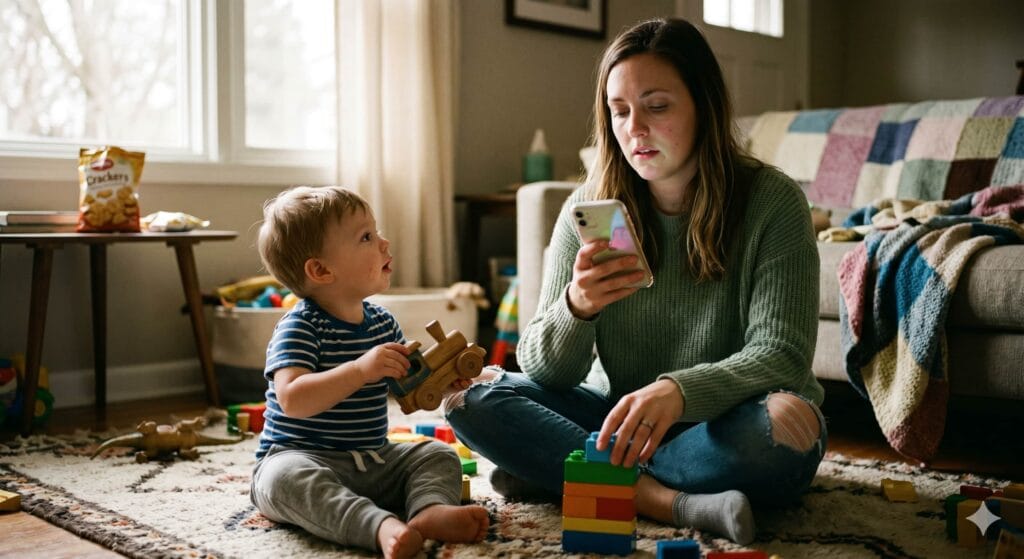
Look, I’m going to go there. Sometimes the problem isn’t the toddler’s screen—it’s ours.
I’ve caught myself “playing” with my kid while actually scrolling through Instagram. My body was there, but my mind was in a different zip code. Toddlers crave “beaming” attention. They want to see our eyes crinkle when we look at them.
When we are constantly on our phones, they feel that disconnect, and often, their behavior gets worse because they are trying to scream us back into the room.
But let’s be kind to ourselves here, too. Parenting is lonely sometimes. The phone is our connection to the outside world. I’m not trying to be screen-free all day. That’s just not real life.—it’s to create “phone-free zones” (like dinner or the first 20 minutes after they wake up) where we are fully, 100% present.
By creating these phone-free zones, we manage our own digital habits while reducing the overall toddler screen time guilt in the household.
Screen-Free Alternatives for “Lazy” Days
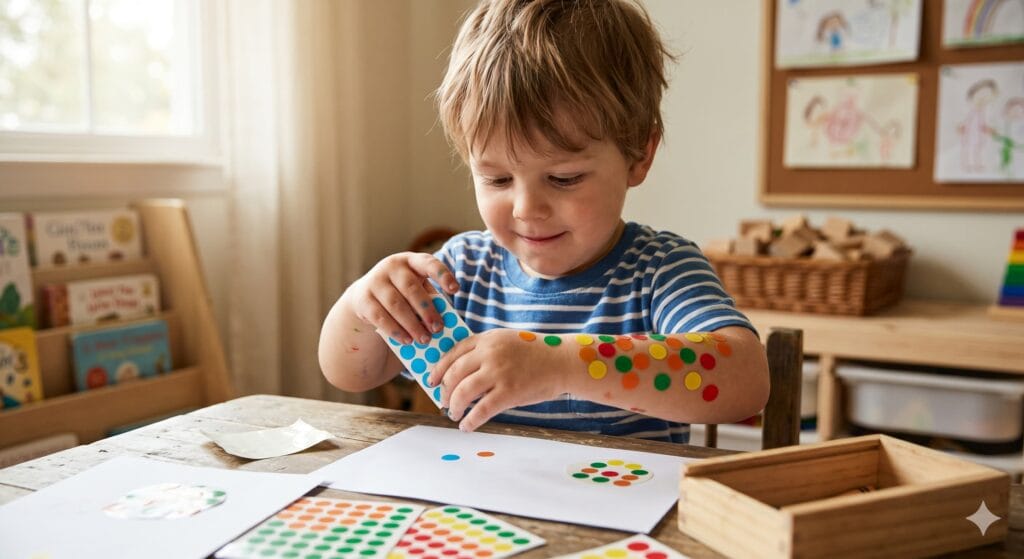
What do you do when you are too tired to play “The Floor is Lava” but you really want the iPad off? You need Low-Prep Survival Activities. * The “Sticker Station”: Give them a sheet of stickers and a piece of paper (or their own leg). It’s quiet, it’s fine-motor work, and it buys you 15 minutes.
- Water in a Tub: Put a towel on the kitchen floor, fill a Tupperware with an inch of water, and give them two cups and a spoon. Toddlers will play with water until their fingers turn into raisins.
- Magnetic Tiles on the Fridge: If you’re cooking, let them build on the fridge. It keeps them in your sight but out of your way.
- The “Audiobook” Trick: Try playing a story or music instead of a video. Wait, I love the audiobook trick. It keeps them busy using their actual imagination, and you don’t have to deal with that weird, glazed-over ‘zombie look’ that comes with the blue light.
Final Thought: Letting Go of Toddler Screen Time Guilt
At the end of the day, your child is going to remember the snuggles, the way you laughed at their silly dances, and the feeling of being loved. They aren’t going to grow up and say, “My life was ruined because Mom let me watch Cocomelon while she dealt with a migraine.”
The truth? We’re just raising kids in a world full of screens. We can’t hide them from WiFi forever, so we might as well teach them how to handle it without losing our minds in the process. So, the next time you hand over the phone so you can drink a hot cup of coffee or take a five-minute breather—drop the guilt. Put it in a box, wrap it in tape, and throw it away. Some days are just survival mode. And that’s still parenting.
Look, I’m literally writing this while my toddler is watching a 5-minute video so I can finish my thought. We’re in this together.
Honestly, you’re doing fine. Even if it doesn’t feel like it in the moment while it’s actually warm.
So, the next time you hand over the phone so you can drink a hot cup of coffee—drop the toddler screen time guilt. You are doing just fine.
Struggling with the screen-time battle today? You aren’t alone. Save this post for the next time the “Mom Guilt” starts talking too loud, and remember: balance is a journey, not a destination.